Showing posts with label Washington DC. Show all posts

Saturday, July 13, 2013

Traversing Kansas


We spent a hot, muggy night outside Topeka and then started to cross the rest of Kansas today. We were going to stop in Hays for the Natural History museum there, but the temperature rose to 108 degrees. We were worried about leaving the cat in an un-air-conditioned trailer, so we kept going to Goodland. Since we arrived early, we enjoyed a swim. Tomorrow, we’ll head home.


A Washington Fourth

So how was the trip? We crossed four items off the bucket list: Winterthur, the 4th of July at the National Mall, the Air and Space Museum annex, and driving the entire Blue Ridge Mountain Parkway. We learned a lot about the President’s from Washington to Eisenhower.  We enjoyed our time with Laura and met her boyfriend, Greg. It was fun to visit Gettysburg, Williamsburg and Jamestown after 20 years. But we should pick some cooler month than July next time.

A video of the trip with more movies and pictures is available on youtube.


Friday, July 12, 2013

Harry Truman Presidential Museum


Our stop for the day was the Truman Library. The first thing that struck me was how unlikely it was for Harry to become President. Harry was a farm boy with just a high school education, who spent his early years helping out his family and working various jobs. There was nothing unusual about him. He went into the army during World War I, where he showed leadership as captain of an artillery unit. Upon returning home, he married Bess his high sweetheart (who had turned him down twice before). Then he went into politics serving as County Judge (really a county commissioner) for 8 of the next 10 years. The Democratic political machine liked him and so he ran for Senator in 1934 and won. He claimed that his happiest 10 years were in the Senate.

Harry Truman is sworn in as President

In 1944, he was proposed as the Vice Presidential candidate for Roosevelt’s fourth term. Three months after taking office, Roosevelt died, leaving Harry as President. He had only met with the President twice. Harry’s presidency was one that really tried him. The win in Europe was good news, but then he had to make the decision of whether to drop the Atomic bomb on Japan (as we discussed in the Texas trip, everyone was worried how many Americans would have to die to conquer Japan city by city). After the war, he was faced with the Soviets occupying most of Eastern Europe, behind that Iron curtain Churchill talked about. He was a strong supporter of the United Nations, NATO, the creation of Israel (being the first to recognize the new country), and the Marshall plan (spending about 20% of our government budget to help out Europe). Then the Soviets blockaded Berlin and Truman was faced with the possibility of another war. He decided upon the Berlin Airlift to supply Berlin rather than forcing the issue with troops. Then came the rise of a Communist China and the Korean War. Not only did Truman have all these foreign challenges, but after the war, he had to deal with employing all those returning soldiers, high inflation after years of rationing and price controls and a dire need for housing for all these new families. Meanwhile, the Republicans gained control of Congress, so most of his “Fair Deal” never made it through Congress. Yet, by 1949, Americans with only 7% of the world’s population was producing almost 50% of the world’s goods. America became a world player both militarily and economically. Not bad, for a farmer from Missouri.

Harry's challenges

Thursday, July 11, 2013

Mammoth Cave


Misty entrance to Mammoth Cave

We camped just outside of Mammoth Cave last night. Most of the tours through the cave involve over 300 steps, so Mary decided not to risk it with her knees. I took the historic tour, which talks about the history of the cave and enters the cave through its natural entrance. Since we arrived at 9:30, there were only 26 on my tour, versus the 121 people we met as we were leaving the cave. The Indians mined the cave for minerals for many centuries. During the War of 1812, there was a salt peter mine here, largely mined by black slaves. They made water pipes out of trees here, coring out the center and stringing the logs into the tunnel. The water was used to separate the salt peter. When the dirt no longer had salt peter it was said to have “petered out”. After the war, the price of salt peter dropped by a factor of 10, so the people began giving tours of the cave. As we walked through the cave, we could see many signatures made by these early cave visitors using their candles including Steven Bishop, who was the first to get past the "bottomless pit" to explore new sections of the cave. Mammoth cave isn’t a particularly pretty cave, there aren’t many of typical cave features caused by water dissolving limestone into various features, because much of the cave is soluble and insoluble layers of rock.  We traversed huge chambers with flat roofs and some connecting passages where we had to duck down and squeeze through.

Fat Man's Remorse

 The fame of Mammoth Cave is that it is the longest cave known, about 400 miles of cave in a 7 square mile area. While my tour didn’t go there, there is also an underground river here which eventually becomes part of the Green River. After visiting the cave, we started the trek through Kentucky, Indiana, and Illinois to stop for the night outside St. Louis, Missouri.


Looking up

Wednesday, July 10, 2013

The Hermitage


The first Hermitage

We left Smoky Mountain National Park this morning and traveled a few more interesting roads until finally reaching some normal highways. We stopped outside Nashville to visit President Andrew Jackson’sHermitage. He bought this land in 1804 and built his first cabin here. He held onto this land, even though he had to sell his more valuable land on the river to pay off his debts. This became a large cotton plantation with its share of slaves.
Andrew Jackson’s life is quite intriguing. He made his fame defeating the British in New Orleans during the War of 1812. He ran for President in 1824, one of four candidates. No one won the Electoral College, so the House of Representatives chose John Quincy Adams. He ran again in 1832, running one of the first Presidential Campaigns, because electors in most states were now chosen by elections, rather than by the state assemblies. Jackson was one of the founders of the Democratic Party. He won in a landslide. He remained quite popular when he vetoed the charter extension for the Second Bank of the United States, which he felt only helped the already rich, not the common man. He was also popular for removing the Indians from the East to west of the Mississippi. This was also known as the Trail of Tears as over 2000 Indians died on the trip. In 1837, Jackson retired back to the Hermitage. The mansion itself was built in 3 stages: 1821 the initial building, 1831 the first expansion, and 1834 repairs after a fire (including putting the kitchen in a separate building). The preservation of this mansion was amazing. Most of the rooms were still decorated with the original French wallpaper (with a scene from Greek Mythology). Most of the furnishings were also original. Over 700 books from Andrew’s library were stocked on the shelves. (It was well preserved because his son, went bankrupt, and ended up selling the estate to the state to turn into a museum. Jackson died in his own bed in 1845.

Hermitage 1837 (backside)

Tuesday, July 9, 2013

Smokey Mountains

Craggy Gardens

Today we completed the last of the 479 mile Blue RidgeParkway. I had been worried that I would be holding up traffic, but in the end, I only had to let cars pass five times in the last 3 days.  There were more cars on the road, especially as we approached Ashville. We also went through 23 of the 26 tunnels on the parkway. We stopped at Craggy Gardens which was at 5600 feet. Here the sides of the road were covered with Mountain Laurel and Rhododendrons. At this elevation, quite a few were still in bloom, even though their season is typically April through June.  We descended several thousand feet, then on to the highest point Richland Balsam at a little over 6000 feet.  Back down again to reach the entry to Smokey Mountain National Park, we could smell our brakes, so it was a good time to stop at the Visitor Center. . The ascent over the Appalachians in the park was anti-climactic after the Blue Ridge Parkway. The only real viewpoint was right at the top, and the parking was overflowing there so we didn’t get to stop. Our camp tonight is in Elkmont campground. We then took the car to Cade’s Cove. This was the site of a small mountain community which started in the early 1800’s until the park was created in the 1930’s. Several homestead cabins are maintained as well as the community churches. (An interesting side light: the churches didn’t operate during the civil war, because of the feuds between those who favored the confederacy and the union.) We encountered lots of creeping cars on this one way loop. Some were scared by the steepness of the road in places, and others would stop in the middle of the road to watch a deer or a turkey, oblivious of the line of cars behind them.

Cantilevered Barn, Cade's Cove


Monday, July 8, 2013

Blue Ridge Parkway

Mable's Mill

We continued down the Blue Ridge Parkway. We're amazed at how little traffic we’ve encountered. In the last two days, I’ve only pulled over three times to let other cars pass. Most people seem to take only a small portion of the parkway to see particular sights. I guess we’re doing the unusual thing by taking all 400 miles. Today, the road was not quite as up and down. The flowers are colorful on the sides of the road, lots of black-eyed-susan, yarrow, milkweed, and an orange flower we have yet to identify. Unfortunately, most of the flowers occur along portions of the road where we can’t stop, so I have yet to grab a picture. We stopped for lunch at Mable’s Mill, with its water powered mill  stones.


The best stop of the day was the Blue Ridge Music Center at the border of Virginia and North Carolina. Every afternoon during the summer they have a band playing blue grass and country music. We had a few people demonstrate their dance to the tunes and a young boy was coaxed into joining in with his fiddle since he had just spent the weekend in fiddling camp. It was a fun time. There is also a museum here explaining the Blue Ridge music traditions with some home-made instruments. Further down the road, we stopped for a short hike to the Cascades. Actually, I thought the cascades were more of a water fall than a cascade at least as viewed from the top. We reached at campsite at Linville Falls about 6:30. I had hoped to hike to the falls, but it was dark by the time we finished dinner.

Fox Hunter's Paradise

Sunday, July 7, 2013

Shenandoah National Park


It was an early morning for everyone. We delivered Laura to the Baltimore airport at 7 AM and Greg to his bus stop at about 7:30 AM. We had a good time with Laura and Greg. Greg was very polite, and a good conversationalist. We were happy to introduce him to some new sights in Washington. It seemed like Laura had a good break from work during the 9 days she was with us and I’m sure she appreciated the time to get to know Greg a little better (though it probably would have been better without those parents always in sight).

View from Skyline Drive

Then we headed off to Shenandoah National Park and the Skyline Drive. The drive follows the ridge line of the Appalachian Mountains. The road was in excellent shape and had recently been repaved, but with all the ups and downs, twists and turns, you can only go about 35 MPH. So the 105 mile length took over 3 hours to traverse. The scenery was superb – lots of views into the valleys – rolling farm land, grassy meadows, multiple mountain ridges, treed wilderness, or towns, the sights changed frequently. Then we started on the Northern most leg of the Blue Ridge Parkway. The road wasn’t quite as good, but you could get up to 45 MPH. There are lots of pull-offs for trails, overlooks and picnic areas. Occasionally it was very obvious that we were on the ridge because you could see down to the valleys on both sides. As we traveled, we were in some real heavy rains, but it cooled the temperatures down into the 60’s. We’ll sleep with a blanket tonight! After our long day, we were eagerly awaiting our campground, Peaks of Otter. But we missed the turn-off, had to go about 3 miles to find a place to double back, then finally found it. While I made reservations to be safe, there were only about 3-4 campers in the whole campground. We didn’t like the site I had reserved, it was a steep, pull through, and so we cheated and took the adjoining campsite, a flat, back-in site.

Saturday, July 6, 2013

Newseum


9/11 Headline

We had planned to walk the monuments this morning. But by 9:30 AM it was 88 degrees out with a real feel of 96 and no clouds in sight. We decided that it would make more sense to spend the day in air conditioning. We had originally planned to go to the Spy Museum, but since Greg is a journalist and only Mary had been to the Newseum, we changed our destination. The Museum was really good. It started out with a section on the Berlin Wall (including a large chunk of the wall) and how journalism was part of the reason it was raised (too many people were leaving East Germany after hearing of the life in the West). One of the temporary exhibits was on how JFK and Jackie used the media to appeal to voters through photographs (especially as a family), news conferences, and the Kennedy-Nixon debate. The main exhibits were quite varied: many front pages of historical events, how radio, then TV, then internet media changed how we receive our news. We viewed an interesting movie on the first amendment, and how difficult the early years were, especially since much of journalism almost became mud-rucking on your opponents. The Sedition Act was passed to control criticism of the government only 7 years after the first amendment was approved (but it was allowed to expire a few years later). There were lots of places you could interact – taking quizzes, playing games, even getting to play TV reporter. We happily spent about 5 hours at the museum.


Photographer's last picture on 9/11


After dinner, we decided to try the monuments again. Since it was already 8 PM, we stopped at the Jefferson Memorial just before sunset. This is one of my favorite monuments with the tidal basin in front with views of the Washington Monument and White House. We tried to see the Martin Luther King Memorial, but couldn’t find a parking place anywhere close to it. So we ended up driving near some of the monuments: FDR’s, Lincoln, World War II and the Washington Monument.


Mary, Laura, Greg, and John at the Tidal Pool

Friday, July 5, 2013

Air and Space Museum

Space Shuttle Discovery

I’ve been waiting to go out to the new addition to the Air and Space Museum, out at Dulles Airport. Here they displayed a lot of spacecraft and planes that are just too big for the downtown museum. As you walk in the first plane that catches your eye is an SR-71 spy plane, designed to fly higher than any missile can reach. Each area of the museum had an aviation theme: Pre-1920, business, stunt, commercial, World War II, Korean, Cold War, vertical flight. Some of my favorites included the Langley Aerodrome which tried to fly like a bird, the Supersonic Concorde, the Boeing 707 (my first airplane flight from Chicago to Paris was on a 707), the gleaming metal of the Boeing 307 Stratoliner, the Virgin Atlantic Global Flier, which flew non-stop around the world, the Enola Gay B-29, which dropped the bomb on Japan, and finally the space hangar with the Discovery shuttle  
and lots of satellites, rockets, and missiles.

SR-71

In the afternoon, we visited Arlington National Cemetery. It still is in the 90s, so we walked the minimum: up to the Kennedys’ grave sites (John, Jackie, Robert, Ted, and Joseph), then to the Tomb of the Unknown Soldier. We arrived at 3:58 PM, just in time for the changing of the guard. We were pretty walked out and hot by the end of the day.

Arlington National Cemetery

Thursday, July 4, 2013

National Mall

Fourth of July Parade

We have a full day planned on the National Mall. First, we went to the NationalMuseum of American History. Only a little over half the museum is open, they’ve been remodeling since the last time we were here (when it was closed). We went through the America at War exhibit (we’ve seen a lot of this during our trip already), the African America exhibit celebrating 150 years since the Emancipation Proclamation and 50 years since the Civil Rights Encounters of the 60s’.
We took a break before lunch and watched the 4th of July parade, just outside the museum. Lots of bands, but they seemed to stretch the parade out quite a bit.  After lunch, we saw the key highlights of the museum: The Presidents, the First Ladies, and the Star Spangled Banner. Then out on the Mall was the Smithsonian Folk Life Festival. Hungarian crafts, dance, and food was just outside the museum. The crowds were thick, leaving just a few single chairs here and there to sit and watch the dancing. But it was interesting watching the craftsmen work especially some of the woodcutters. It didn’t take long for us to get overly hot in the 90 degree heat, so we went on the National Museum of Natural History, which was packed with people. We went immediately to the gem exhibit – the necklace worn by Marie Antoinette was particularly spectacular as well as a huge aquamarine stone. We explored the insect world from butterflies to leaf cutter ants to all sorts of insects disguised as leaves. Then on to mammals, where we found a few new ones, we had never seen before. We ate at the museum and rested our weary legs for a while. Then we hiked down the mall to the Capital, it took almost an hour to get through security for the Capital Fourth Concert. We arrived too late for a direct view of the stage, but we could see the giant monitor above the stage and hear the concert quite well. Barry Manilow, Neal Diamond, and John Williams conducting music from the recent movie “Lincoln” were the featured artists but they also had a variety of folks from American Idol and America’s got Talent.


Then came the fireworks with the bands playing Sousa Marches, and the 1812 Overture among others. Our view was somewhat obscured by the trees, but anything that went above the Washington monument was clearly in sight. Chalk up a bucket list item – we now done the National Mall on the Fourth of July.

Wednesday, July 3, 2013

Mount Vernon


Our major stop for the day is Mt Vernon, home of George Washington. The house itself was much like we remembered – a very large house for the time. Especially after he had been President, they entertained a lot. George experimented with a lot of different crops in his garden, rather than just plant the cash crop of tobacco. A large museum has been added since we were here last. Inside was a lot of Washington furnishings: from farm tools to his presidential chair to the first Presidential china. (We had seen some a few days ago in Winterthur and would see some the next day in the Smithsonian. )Following the artifacts was a museum giving George’s life story. We’ve already covered much of that at Fort Necessity and Yorktown. The key additions to the story we learned about were after the Revolutionary War. Washington could have been King George, but instead he decided to retire to his farm after being the General Washington. Of course, he was called upon to be the first President and while in office, he was careful about the precedents he set. From simple things, like being called “Mr. President” versus “Your Excellency” to the more controversial items like setting up a Federal bank to coin money and creating a cabinet of advisors. We had about 2 hours to visit but 3 hours would have been more comfortable.

Mount Vernon

We made it to our campsite about 3:45 PM. Laura’s boyfriend, Greg, was supposed to arrive about 4 PM, thankfully he was late and we picked him up about 5:15 PM from Union Station. He’s going to spend the 4th of July weekend with us. (Since Laura met him online, this is only the second time they’ve been together.)

Tuesday, July 2, 2013

Colonial Willamsburg


Capital Building

We headed off to Colonial Williamsburg to head back into the 18th century during the years just before the revolution. Most of the major buildings were rebuilt in the 1930’s on the foundations of the original buildings, but several of the houses are original. We spent most of the day here, and probably should have spent 2 days. In every building, people either explained the story behind the family that lived there or recreated the trade that was practiced in that building. The Capitol building is an H shape. On one side was the House of Burgesses, who were elected by the people. On the other side on the top floor was the Governor and his advisors appointed by the crown in the upper chamber. The governor and his advisors also acted as the executive branch and the judicial branch. Legislation had to pass both houses. In the bar of the H was the committee room for negotiations when the two houses didn’t agree. All legislation had to also be approved by the governor and the King of England to become law. The Judicial chamber was below the governor’s room. All felony offenses were tried here. At least 5 of the governor’s cabinet had to sit at trial. In front of them was the bar which separated the prisoner who “stood trial” there. Meanwhile the lawyers could “pass the bar” and sit in front of the judges. And, of course, witnesses took “the stand”.

Baby's Corset


We visited many of the trades: carpenters, silver smith, millinery, apothecary, the book binder, and the coffee house. Our most interesting house was Peyton Reynolds, who served as a burgess, and President of the Continental Congress. This was a large luxury house: lots of wood paneling, glass windows, paintings, and linen. A unique item was in the kitchen – an automatic spit, called a clock jack, invented by Leonardo Di Vinci which used a weight to turn the spit.
Then the lightning storm and a pouring rain began as we were waiting to enter the Courthouse. We eventually gave up so that we could tour the Governor’s Palace. The house was meant to impress – the main hall is filled with swords, pistols, and rifles, which could be removed from the walls in less than an hour if needed. It also had the usual parlor and meeting rooms, but also had private spaces for the governor and his wife. Finally, they had a dining room and a hall for dancing. We heard the story of how the last royally appointed governor left in a hurry after he tried removing all of the gun powder from the armory. A revolt almost started, but was calmed down, but then the people heard that the king had ordered the same thing to be done in each of the colonies.

Entrance into Governor's Palace

Monday, July 1, 2013

Yorktown and Jamestown


We woke up to a pouring rain and there are flash flooding warnings for the day. So we decided to head to Yorktown Victory Center since it was a combination of indoor and outdoor exhibits. There were two outdoor exhibits, first was a 18th century farm. We toured the vegetable garden filled with vegetables from that era as well as the many herbs used for flavoring or to cure everything from depression to mosquito bites. In the kitchen they were storing food using four methods: salting vegetables and meats, drying vegetables, smoking meats, and pickling fruits and vegetables with vinegar made from apples. The museum presented the story of the revolutionary war, ending here in Yorktown. The British were trapped by Washington’s army on land and the French warship blockade from the sea. After continual pounding from artillery, Cornwallis surrendered – the last battle of the war. Washington actually lost more battles than he won, but the war was won, thanks to the help of the French.

Outside the museum was depicted a army encampment. They fired the artillery for us – at the time, muskets could fire only 100 yards, but a cannonball could be fired one mile. The object wasn’t necessarily to kill a lot of men, but to frighten the army into retreating. As they got closer you could use shrapnel, small balls packed into a small canister which could be fired about 300 yards, filling the area with shot. The doctor explained medicine of the time: they cured fever by bleeding you (obviously you had too much warm blood), if you had diarrhea, they used Castor oil to remove all the bad stuff in your intestines (causing you to become dehydrated). They had some success with removing bullets and shot with their fingers or a forceps (only 70% died), and their most successful operation was for concussions (they would open up a hole in your skull to remove the pressure (80% survived).

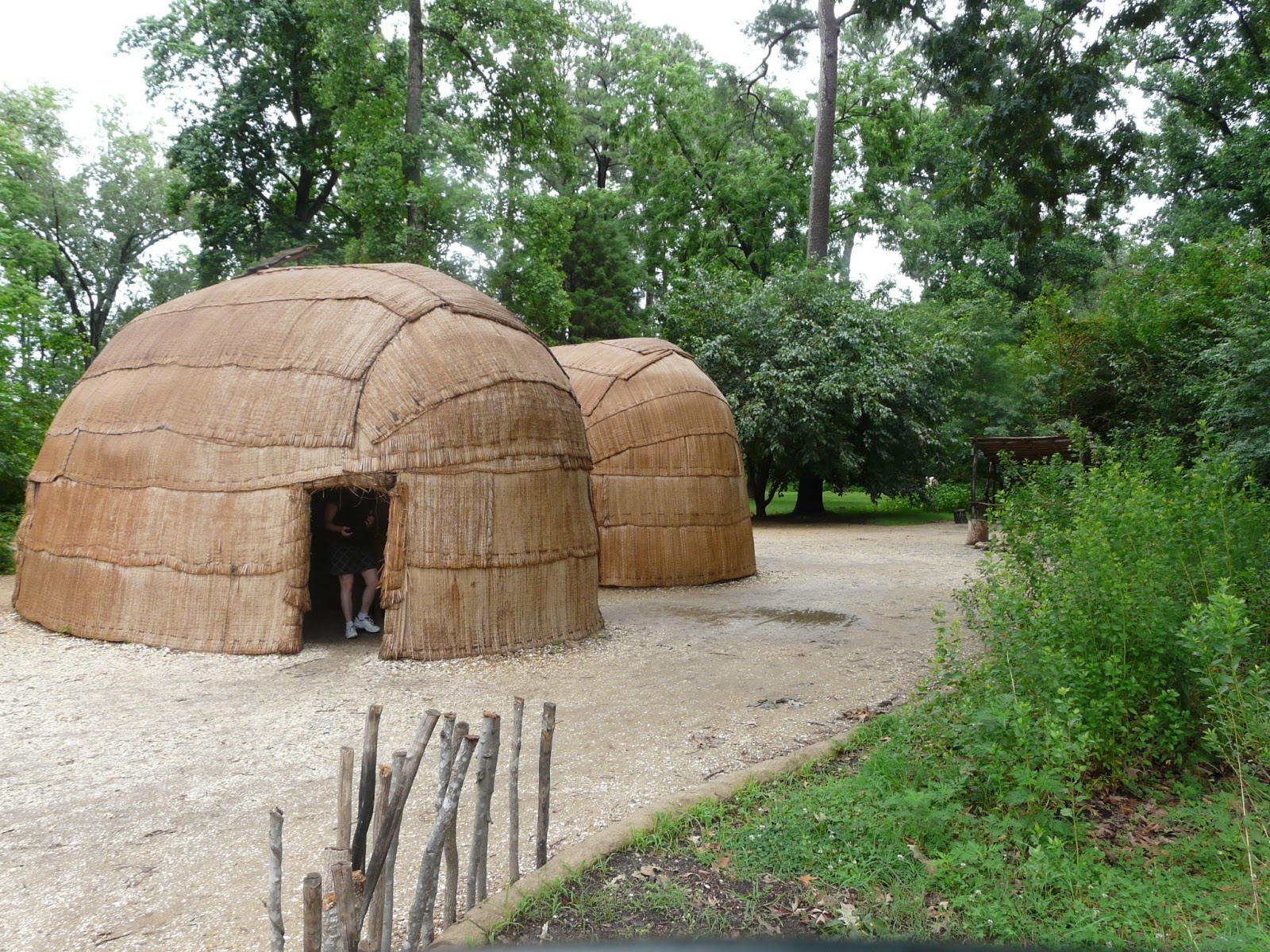
Powhatan Indian Village


Then we went on to the Jamestown Settlement, again a combination of indoor museum and outdoor exhibits. Outdoors was a typical Powhatan Indian village for the region with numerous oblong lodges. A replica of the Fort built in 1607 when Jamestown was settled. It was a triangular shape and the first building built were the armory, the storehouse, and the church. After that were houses and finally the Governor’s residence. It was fairly plain, but large, with a meeting room, parlor, and the Governor’s bedroom as well as smaller bedrooms upstairs. Finally they had replicas of the three ships that made the 144 day trip to Jamestown from England: the Susan Constant, the Godspeed, and the Discovery. The colony really struggled – starvation, disease, and fighting with the Indians. For over fifty years, the death rate was higher than the birth rate (of course, there weren’t many women), so the town was dependent upon ships from England for both new settlers and supplies. The exhibits described the history from pre-European times until the capital was moved from Jamestown to Williamsburg.

The Susan Constant

Sunday, June 30, 2013

Fredericksburg, VA


Mary Washington's home

We’re headed down from Baltimore to Williamsburg, Virginia. On the way, we stop in Fredericksburg’s Historic Section. Our first stop was Mary Washington’s home. It was bought by her son, George and expanded to house his mother in style at age 64. She ended up living there for 17 more years. The house while simple also was quite large, especially for a single woman. She had a large formal parlor on one side of the house, only opened up when she was entertaining. On the other side was her bedroom/living room and upstairs were three small bedrooms for guests. The house had a few of her possessions, but was mostly filled with period pieces.

Rising Sun Tavern

The best spot of the day was the Rising Sun Tavern. This tavern was run by one George Washington’s brothers for five years or so. The tour explained how mostly men would stay at the inn. The gentleman (staying with a meal cost about 2 days wages) would share a bed, while the commoners would have a hay comforter with no blankets. Women had a separate room where they would read or do their handy work. Generally, the women had to get up about 2 AM to be ready for the carriage that would leave at 4 AM to make the next tavern about 15 miles away by nightfall. The best part of the tour, however, was learning the why’s behind many common expressions: You could play cards with a deck of 52 cards, 51 cards were free, but there was a tax on the ace of spades. So many played with just 51 cards: “he’s not playing with a full deck”. The ale was poured in a pewter mug with a glass bottom: “Here’s looking at you” as you drank and could see through the bottom. When the British would impress new seaman, they often would put shillings in the bottom of the cup, and when you drank from it, they could impress you, since you had accepted the king’s money: “bottoms up” was the call to make sure there were no coins in the bottom. At night, your boots would be shined, at the time, both boots were identical and by wearing them on one foot or the other the boot would be shaped. “Putting your right foot forward” implied that the right boot was hung upright.  

James Monroe Museum

Our final stop was James Monroe’s Museum, the fifth president of the United States. It did the usual job of pointing out his role as a young captain in the Revolutionary War, how we served as a politician in Virginia after the war, both in the legislature and as governor, serving as ambassador to France, and finally as President. His eight years as President were relatively peaceful, a time of prosperity for the Republic. He is best known for the Monroe doctrine – a policy that no Western Hemisphere country once free, should be further interfered with by outside powers. This doctrine was used at the time, to stop Spain from recolonizing South America. But it is still evoked today: Kennedy to stop the USSR from arming Cuba, Regan invading Grenada, and Bush, Nicaragua. I was quite impressed at how many Monroe artifacts were in the museum: swords, his rifle, various writings, and the desk he used to sign the Monroe doctrine. The museum was established by his descendants in the early 1900’s, it was obvious that they had preserved quite a few of his possessions.

Saturday, June 29, 2013

Chesapeake Bay


Chesapeake Bay Lighthouse

Today, we took the Chesapeake Bay Bridge to the eastern side of Chesapeake Bay and the Maritime Museum in St. Michaels. At first, we were somewhat disappointed in the museum, they were reconstructing a few typical Chesapeake boats, and there were a few light houses and a display about playing on the water (the rise of the Yacht set in the 1920’s). The lighthouse we saw was different than the typical tall circular building, this was actually a hexagon shape, and apparently there over 20 of these style light houses in the Bay. Then we noticed that the museum went along the shoreline and there were large displays explaining about crabbing in the bay. Did you know that a soft shell crab, is actually a crab that just molted its old shell and hasn’t hardened his new shell? There was also an oyster factory and an oyster boat with all their equipment. Actually, the museum did a good job of understanding how important the Bay was to the economy of Maryland. But, of course, the current problem is the decline in crabs and oysters over the years. Yet even today, there enough oysters to completely filter the bay twice a week. The temporary exhibit was on the war of 1812, the forgotten war. The three items the majority of people remember about the war are: the White House was burned, the Star Spangled Banner was written from the moment when the American flag was still flying over Fort McHenry after the British bombardment, and that Jackson won the battle of New Orleans after the war was over. The exhibit filled in some of the details especially the battles up and down Chesapeake Bay. It also pointed out that the treaty pretty much left things as they were before the war, except that the British agreed not to impress Americans into the King’s Navy. We had lunch at a Bistro in the town and then continued down the peninsula until we had water on all three sides of us.


Crabbing Boats

Friday, June 28, 2013

Winterthur


Winterthur Parlor with Chinese wallpaper

We headed up to Delaware to visit Winterthur, one of the DuPont mansions. Henry Francis DuPont was the primary benefactor of this estate. In the early 1900’s he inherited a 30 room mansion along with 2500 acres of land. His major contribution to the world was the Holstein-Friesian dairy cow. He won several awards for the most productive dairy farm. Today, over 90% of dairy cows are Holstein cows. While most of the rich were collecting European art and décor, Henry decided to collect American decorative arts. He expanded his mansion from 30 rooms to 175 rooms, primarily with the intention of eventually turning it into a museum. He presented a real challenge to his architects. He would buy a historic home to take it apart and recreate some of the rooms in his home. For example, one room was paneled with the room panels from a 17th century home. Another has the original staircase from a Southern Mansion that was going to be demolished, but he stretched it to cover two floors instead of one. The Parlor of the house was designed to fit the Chinese wallpaper, he had found on a visit to France (still in its original rolls).When the room was found to be too short, he curved the walls into the ceiling so that he didn’t have to cut the wallpaper. Each room is filled with furnishings from a particular period as well as American art. Some of the more interesting parts of the collection, included a China set used originally by Washington, and eventually bought by General Lee, a Washington portrait by Stewart, and an incomplete painting of the signing of the Treaty of Paris (ending the Revolutionary War, the British refused to sit for the painting). We only visited about 20 of the 175 rooms, on three of the nine floors.

Spiral Staircase

Around the mansion were gardens filled with trees, ground cover, and perennials. Most of these gardens were planted under the supervision of Henry. The flowers bloom at different times of the year, so the gardens change naturally throughout the year. A recent addition was the Enchanted Woods, designed as a playground for children. There we found a giant bird’s nest, a witch’s house, as well as a stone cottage. While visiting we heard a siren, warning of lightning storm approaching. A tram comes by and quickly takes us to our car before the downpour.

House in Enchanted Woods

Thursday, June 27, 2013

Gettysburg


Cyclorama: Battle of Gettysburg

The Battle of Gettysburg was fought July 1st through 3rd, 150 years ago in 1863. That was where we spent most of afternoon. The visitor center has been upgraded significantly since the last time we were here over twenty years ago. We started with the film which illustrated the whys and wherefores of the battle. After the film, we visited the Cyclorama, a 360 degree painting of the third day of the battle, painted by a French painter in the late 1800’s. The painting has spent 5 years in restoration and the presentation has been made much more dramatic with added scenery making a 3D effect to the painting and dramatic lighting to make the battle seem to occur before your eyes. This was followed by the museum, which provided a lot of the war background and with many artifacts. Finally, we took the bus tour of the battlefield. This really helped us visualize the battle as we could view the terrain. Much of the battlefield has been restored to what it looked like in 1863. 

General Lee was hoping to dishearten the Union by striking in Pennsylvania rather than continuing to fight inconclusive battles in Virginia. He was hoping to spend most of the summer here, resupplying his army with food (remember most of the farms in Virginia had witnessed two years of war).  He had remained hidden from the Union Army until he was seen by a Union cavalry regiment just west of Gettysburg. General Buford wanted to hold them west of Gettysburg until reinforcements arrived, since Gettysburg had 12 roads coming into it, making it ideal for moving troops. They started by trying to hold Seminary Hill, but even with reinforcements they had to fall back to Cemetery Hill, south of town by the end of the day. From the bus tour, you could see that troops were fighting with as little as 20 yards between the two armies. 17000 soldiers were killed, wounded or missing that first day. During the night, more reinforcements arrived for both armies. The Union army formed a hook formation, primarily on the high ground, while the Confederate army was hidden in the forest opposite the hook.

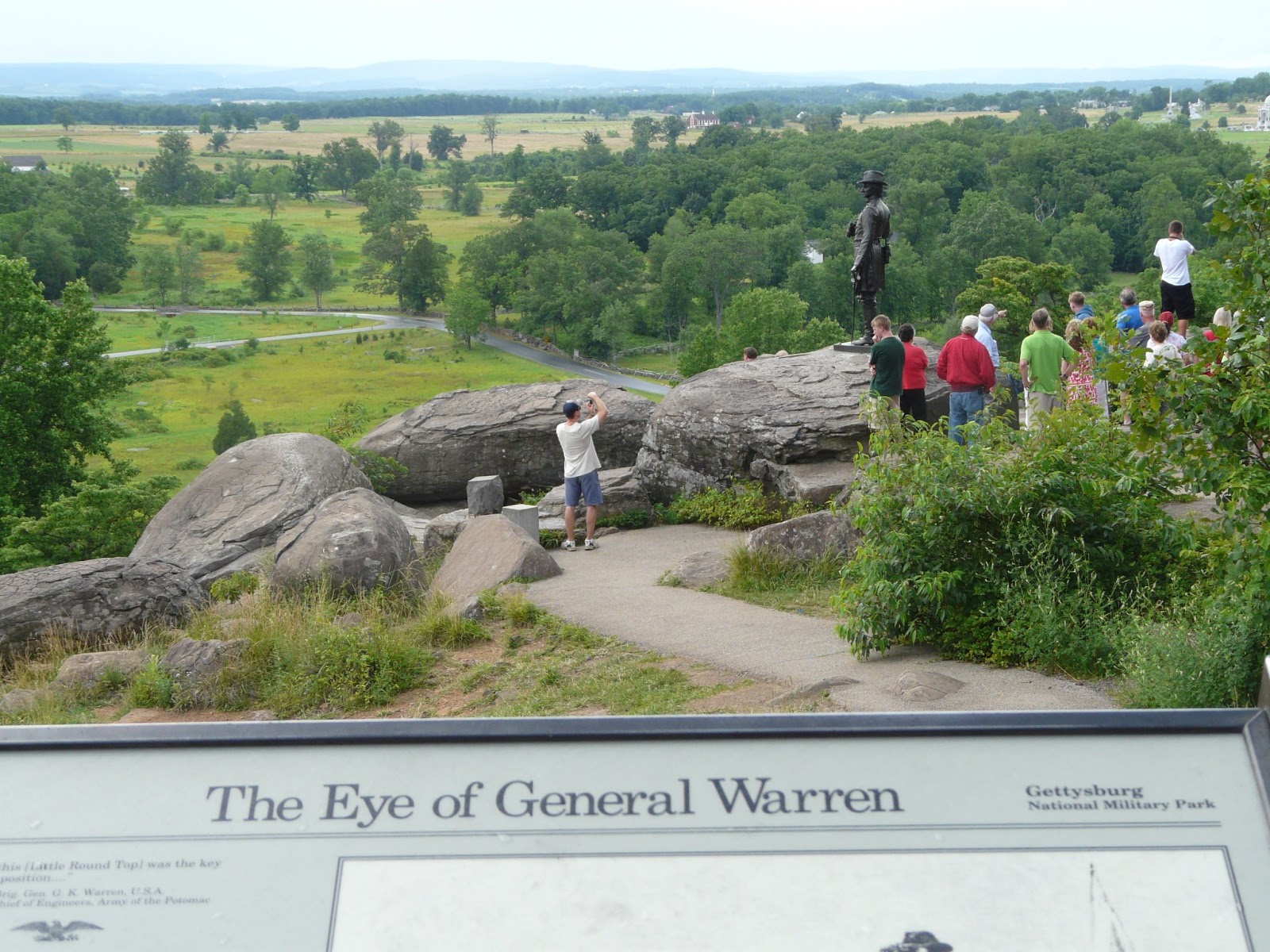
On day 2, General Lee tried to attack both flanks. The problem was that he couldn’t tell where the end of the Union army was on the South end. We could see how the rolling landscape hid the Southernmost portion of the Union army from Lee’s vantage point, and he had no cavalry regiments to scout where it was. He attacked but it turned out not to be the flank of the formation. One of the Union generals had advanced his army out into a peach orchard creating a bulge in the line and stretching them fairly thin.  He ended up retreating, and losing 40% of his men in the process. One of the more interesting stops on our bus tour was Little Round Top, a rocky formation at the end of the Union line. At the start of the battle, no one was up here, yet it had a commanding view of the entire battlefield. The Union army managed to get troops up here, 10 minutes before the confederate army attacked. They managed to hold the hill, ending the second day of the battle.
View from Little Round Top

On Day 3, General Lee having failed to flank the Union army, decided that the middle of the line must be weak, and thus that was the place to attack. This was the site of the famed Pickett’s charge, twelve thousand men strong. Before the charge, the confederates bombarded the union lines with 120 cannon. But the smoke was so thick, they actually fired past the union lines. General Meade ordered the 100 Union cannon to slowly drop out, as if they had been destroyed. Once Pickett began his charge all the cannon started cutting down his men. Only about 200 men reached the Union lines, where hand to hand fighting began. Once again, the Union lines held. General Lee had suffered his first major defeat, and he ended up retreating back to Virginia.

Site of Pickett's Charge

We found Patapsco Valley State Park/Hollofield about 20 minutes away from the Baltimore airport. We’re just outside a city, but deep in the woods. We picked up Laura at the airport that night.

Wednesday, June 26, 2013

Fort Necessity and the National Road


Fort Necessity

The day opened with 300 miles of traveling into Pennsylvania. Our one stop for the day was Fort Necessity. The Ohio territory was just being settled when a small force of Virginia soldiers, led by George Washington was sent in 1753 to build a road to a Fort established near the present site of Pittsburgh, where the Ohio River begins. But the French had taken over the Fort. They decided to build a small fort, Fort Necessity within 2 days ride of the French. They encountered a French patrol, and ten Frenchmen were killed. But the French came back in force and Washington was defeated here, the first battle of what Americans call the French and Indian war or the European’s call the Seven Year War between the French and the British. One of their many wars, but the first one that didn’t end in a stalemate. Britain won, giving them their American colony, India, several Caribbean islands; filling out the British Empire. But they almost went bankrupt and needed new revenues. Those taxes were part of the cause of the American Revolution.  Washington later purchased land nearby and became convinced that a National Road was needed to connect the wilds of the Midwest to the Eastern states (otherwise they might ship their goods down the Mississippi to French Louisiana. This road was constructed beginning in 1811, the first road financed by the Federal government. Here we visited the Washington Inn, built in 1827 as a way station on the road. (The road eventually was replaced by railroads, only to be rebuilt as US 40 in the 1920s.)

The Washington Inn

Tuesday, June 25, 2013

Lincoln Museum, Springfield, Il.


Lincoln as a boy

We arrived in Springfield, Illinois last night about 4 PM. Besides being the capital of Illinois, it has all things Lincoln. Here Lincoln had his law practice and served as a state legislator. Rather than visit a few of the historic sites, we decided to visit the Lincoln Museum and Library. This is a relatively new facility designed to provide an entertaining summary of Lincoln’s life and legacy. It almost felt like a Disney creation, designed to keep children interested in the subject. There were many scenes of his life set up with life-size figures as well as three multimedia presentations. The first section started with his growing up in a log cabin, learning to read, becoming a lawyer, falling in love with Mary Todd, having 4 sons (3 of whom died before he did), running for office numerous times, eventually becoming a congressman, but failing at his senate bid against Steven Douglas. The first movie was on the ‘eyes of Lincoln’ what he saw, what emotions he went through in his life, especially around the issue of slavery. One of the more interesting aspects was how quickly his face aged in his 4+ years as president. The second section focused on the White House years. A fun fake TV program with Tim Russert covered the platforms of the 4 candidates for President in 1860. (Lincoln won in the electoral college with about 40% of the popular vote.)  One of the most interesting aspects was two full walls of political cartoons of his time – most of them pretty wicked on various topics including how his election caused the split-up of the Union, and the dangers of the emancipation act. It was interesting to find out that more people saw Lincoln’s casket after his assassination on the train ride back to Springfield than had seen him as a Presidential candidate.

The Lincoln Family

We traveled on to just outside Dayton, Ohio for our camp spot for the night.

Monday, June 24, 2013

Winston Churchill Museum


Winston Churchill Musem

We continued our World War II theme today, visiting the Winston Churchill museum at Westminster College in Fulton, MO. Winston was raised in a noble, but poor family. His father had been in politics rising to Chancellor of the Excelsior. Winston barely made it through military school. His grades weren’t high enough for the infantry, but he did join the cavalry. Winston served in India as well as participating in the last charge of the British Calvary in Sudan. During his military career, he also served as a war correspondent. This would start him on a writing career, which ended up being his livelihood. He wrote numerous articles and books throughout his life. Winston began his political career at an early age. He would serve on and off for fifty years, handling many minister posts including being Chancellor of the Excelsior. He was out of office in the 1930’s and spent much of that time warning about the rise of Germany. He became prime minister just months before the beginning of World War II. This was his finest hour – he was known for keeping up the courage of the British people. His first speech talked of: "I have nothing to offer but blood, toil, tears, and sweat".  Another during the Battle of Britain declared, "Never in the field of human conflict was so much owed by so many to so few". And after the allied victory in North Africa: "This is not the end. It is not even the beginning of the end. But it is, perhaps, the end of the beginning." 
Why is this museum at Westminster College? This is where he gave his “iron curtain” speech about the control of Eastern Europe by the USSR. The museum is actually in the basement of Church of St. Mary, Aldermanbury, designed by Christopher Wren, but destroyed during World War II blitz. It has been reconstructed here, stone by stone.

Church of St. Mary Aldermanbury