Showing posts with label Great Rivers of Europe. Show all posts

Monday, July 1, 2019

Vienna


Vienna has 2 million of Austria’s 8 Million people. It is very international, over 50% of the population are immigrants. The city-provided affordable housing consciously tries to mix people with different backgrounds to avoid the immigrant problems of other countries. We started with a bus tour, primarily along the ring road. The road was constructed where the city walls used to be. The center of the city consists of 1/3 parks, 1/3 government buildings, and 1/3 residences and businesses. Much more interesting was the walking tour, which crossed from one side of the ring to the other. 

Jewish Synagogue

First stop was the synagogue, which looked more like an office building than a temple of worship. This building survived, because the Nazi’s used the archives housed there to identify and subsequently kill over 70,000 of Viennese’s Jews. Vienna is primarily a Catholic city, in fact non-Catholic churches were banned until 1826. St. Stephen’s Church dominates the central city with it’s 450 foot tower. Some of us walked up the tower, others took an elevator up to the smaller tower. 

Atop St. Stephen's

One of the more interesting monuments is the Black Plague Monument dedicated to the Holy Trinity. The theme is that faith conquers the plague, but it also prominently shows Emperor Leopold with angels surrounding him. At the time, people thought that drinking wine or beer would keep the plague away. As we walked further we came upon the Hofburg, the Imperial Palace, where they were hosting the Italian prime minister. Nearby is the Spanish Riding School, but the horses are on vacation (from July 1st), so we just saw some of the stables. Finally, we ended our tour in the Volksgarden, the people’s garden. Everyone was pretty exhausted from the 90+ degree heat. In fact, only a few folks ventured out that afternoon, because you would sweat through your clothes in about 15 minutes in the sun. I did take a short walk to a nearby island, where people were sunbathing.

Volksgarden (people's garden)

The story of a Syrian Refugee

That evening we had a lecture by Ahmad, a Syrian refuge. His father was an Aeronautical Engineer, his mother a nurse. They had lived in Aleppo, but moved in with relatives in a small town in 2012, because of the fighting in Aleppo. His father was ordered into the military in 2013, but instead fled to Turkey. The family joined him in a refugee camp in August 2014, the family of 5 lived in 21 square yards. Ahmad learned Turkish while in the camp. But he knew he had to make a life for himself. His father sold some land in their small village which provided money for Ahmad to find a better life. It cost him $1100 to take a rubber boat to Lesbos Greece. There were 66 people in the boat, and someone was randomly chosen to drive the boat. 6 hours to cross the sea, 2 days to walk to the nearest village, where they could buy food. Ten of them then took a boat to Athens and a bus to Macedonia where they were stopped by police and directed to a camp. Eventually they walked into Serbia, asking for new asylum papers every time they crossed a border. From here they took a bus to Belgrade where a smuggler said that he could get them into Hungary. Ahmad ended up using 3 smugglers, because each would take them only part way, and then demand more money.  He eventually walked into Austria, where he applied for Austrian asylum in November, 2015. He was granted asylum after 2 months. He was assisted in learning German, provided health care and rent and just today was accepted for a mechanical engineering degree in the technical university. "Austria has offered me a new life and I have no fear of being deported. The journey didn’t require just money, you had to leave your family, friends, and culture. Those who couldn’t afford to pay smugglers are still in the camps, facing terrible health conditions, it’s like being in prison."
His family was also smuggled into Greece, but he lost touch with them, and wasn’t sure they had made it across the sea. They took a different path and now live in Germany. His father and sister are employed there. But they were lucky, many more people were robbed by the smugglers, since you have to carry everything you own on your body.

Our program Directors wrote a poem about our trip:

The Great Rivers of Europe – A special journey
(A farewell poem by Program Directors Mihai, Stefan and Michal)


So you were sitting at home and drinking your tea
Wondering which part of the world you should see
You picked up the phone and booked this great trip
To travel the rivers of Europe by ship

From all over the States, you traveled to see
Europe, your Captain, your Crew and PD
But instead of seeing the Captain waving to you from the dock
We stayed in a hotel, ‘cause there’s been a trashed lock

Woke up in Amsterdam, we went to explore
Canals, cheese, tulips and bikers’ galore
What a free country, you’re looking around
Just where is that husband? He better be found

On the way to Cologne, we traveled by bus
We had a great time, except one of us:
Michal learned a hard lesson that in this great heat
There are things at gas stations you just shouldn’t eat

Then Koblenz was such a peculiar place
The eye roller stuck out his tongue and made a weird face
We hopped on a boat and sailed down the Rhine
And listened to legends about the castles and wine

The weather was perfect and great news we have got!
Staying four nights in Frankfurt – that we would not.
Not four, not three and not even two
A final night at the hotel, yes that would do.

Traveling eagerly to Heidelberg city
Poor students imprisoned, oh what a pity
The castle on top has a wonderful view
There is meat in Maultaschen, believe me, it’s true

On the way back, what a delight
The MS Adagio is coming in sight
We laugh and we cheer as we get off the bus
Cause the crew and the captain are waiting for us!

We have seen Wertheim! What a quaint little town
Where Glassblower Dieter was being a clown
Nice German families gave us coffee and cake
A lot of new friends on that day we did make


Ursula taught us the past of this place
Where Jewish folk had hardships to face
We started sailing on the river Main
To enjoy Wurzburg, its bridge and its wine

Rothenburg included! What a sweet deal
Exploring medieval times with zest and with zeal
There’s piggies in Schweinfurt and in Bamberg there’s beer
But where was that nice church, it’s not at all clear

We keep sailing for days and for days
All of the towns pass by in a haze
Regensburg, Nurnberg, Passau and Melk
What order they’re in? It’s getting harder to tell

We sail and we live and we laugh and we learn
And it the sunshine we stand and we burn
We relax at the ship and we have a drink
While Andreas talks politics and is making us think

In Regensburg city, packed full of towers
We ate local sausage to regain our powers
Brigitta explained to us how German schools work
Then we had dinner and again it was pork!

Then in Passau with its great organ so old
We ate pralines which were made out of gold
We entered Austria and we saw the Melk abbey
You have to admit, that wasn’t too shabby

All the way to Vienna, we have made our way
We’ve attended a concert – oh what a day
Exploring this grandiose, imperial city
The trip is now ending – oh what a pity

One final talk by a lovely guest
He was a bit different from all of the rest
Ahmad had really gone through a lot
And taught us to value the things that we got

So here we all are, our hearts filled with sorrow
And we will be bidding farewell when we come to the morrow
So to here’s to the Greens, the Reds and also the Blues
And here’s to our lovely and wonderful cruise

We know this is sad, for us and for you
But all things have an end. Only a sausage has two.
So let us all agree on this one thing my friends
It’s not farewell but until we meet again

Trip Summary

While we were disappointed that we had 4 days of busing and hotels at the start of the cruise, it was well-handled with lunch money for everyone and nice hotels in the center of town. The busing gave us more time in Amsterdam which many folks made good use of. As usual, the crew was friendly, the program directors were top-notch, and the food was great! I would highly recommend doing the Brugge pre-trip, we particularly would recommend the optional tour to Flanders Field. Nuremberg was a highlight of the trip, as were the educational speakers brought in. We had twelve of us that booked this trip together and we thoroughly enjoyed everyone's company. If you want to see more pictures and videos, a 23 minute narrated video is available on youtube

Most of our twelve at the Opera


Sunday, June 30, 2019

Melk, Austria


Melk Monastery

The Melk monastery dominates this town. Founded in 913, the original building was a fortress. The monastery was completely redone 300 years ago in Baroque style. There are 470 rooms and 1365 windows. There appear to be a lot of gold statues, but most of these are wood statues gilded in gold. Today the monastery has 30 monks, but it also has 900 gymnasium students. The tour of the monastery is primarily along the 600 foot long imperial corridor which were the rooms were guests would stay. Today the corridor houses exhibits and artifacts about the history of the benedictine monastery. The Benedictine philosophy is to pray, work and read. Monks would stay at the same abbey, swore obedience to the abbot, and were to continually move forward. Most impressive was the Marble Hall, built of stucco, the library, and the church.

The Library


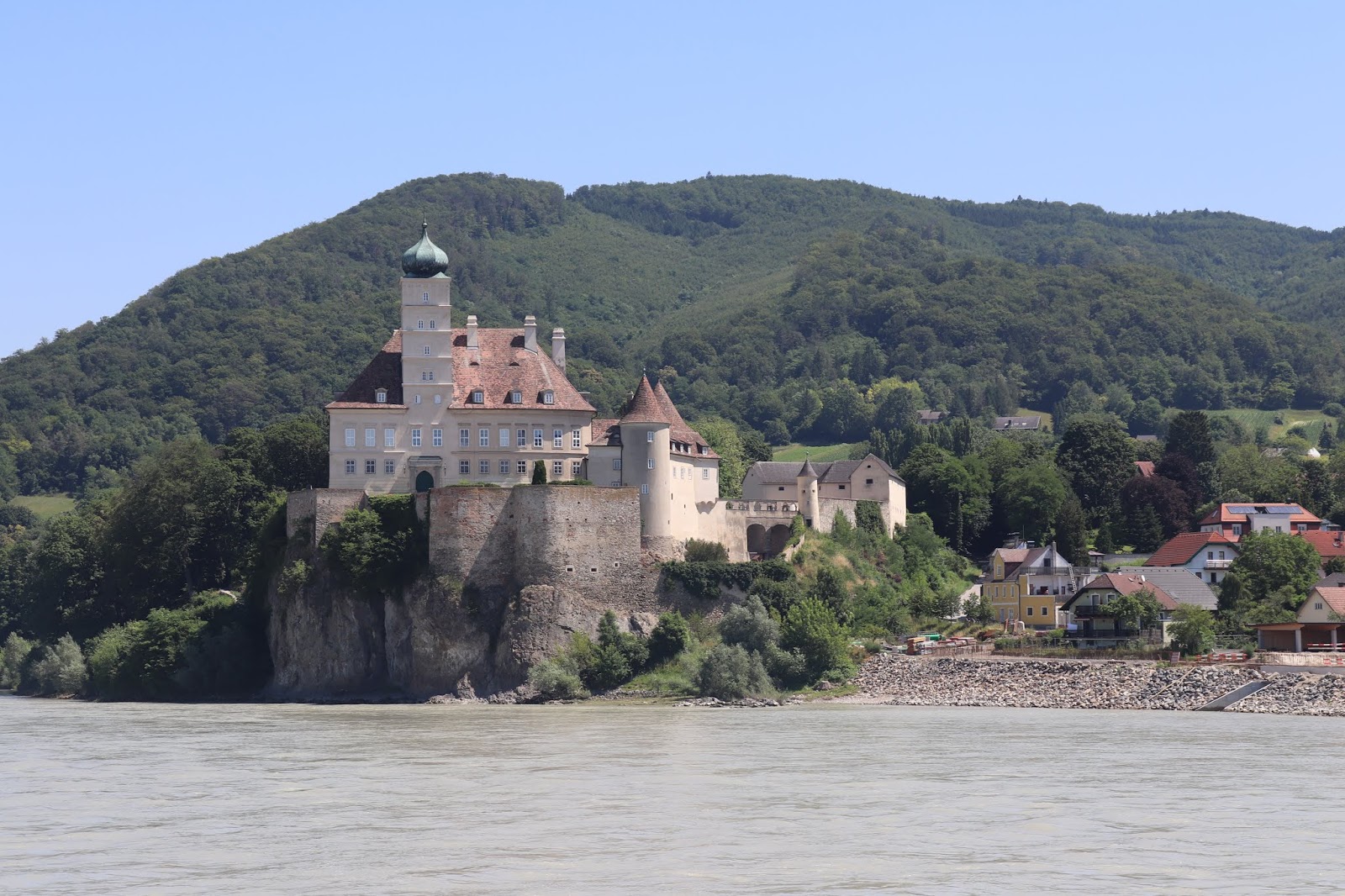
Sailing out of Melk, we went through the Wachau valley, surrounded by hills. The valley is famous for its white wines and apricots. Apricots were planted here after a disease devastated the grapes. Apricots provided a source of income until grapes could be replanted. We saw a number of castle ruins as we went down the valley. These castles were used to defend against the Hungarians.

Schoenbuehel Castle


We arrived in Vienna, in the late afternoon. That evening we went to a wonderful concert of Strauss, Mozart, and some opera movements. It was just what you expected to see and hear in Vienna.

Viennese Concert


Saturday, June 29, 2019

Passau

Approaching Passau

Passau is another town that became rich at the confluence of the Inn, Ist, and Danube rivers. Salt mined in Austria was the principle trade good passing through. We walked along the Danube to the painted baroque town hall and next door was the executioners house. The executioner had two other jobs: He was also the town torturer, but because you couldn't kill the suspect with torture, he was also a doctor. Torture was encouraged by the church as a way to cleanse the soul, allowing the sinner to go to heaven. Being the town executioner was a family job, but who would want to marry an executioner? It was often the daughter of another town's executioner.

The back section of St. Stephan's organ

The scenic highlight is St. Stephen's Cathedral. The bells were ringing loudly to announce the ordination of a priest the morning we were there. At noon, we attended a organ concert. This was the largest pipe organ in the world when it was built in 1928 and has five different pipe sections with over 17000 pipes . I got goose bumps from the sound.

On the opposite side from Passau is Veste Oberhaus, the fortress on the hill, built originally in 1255, with a major renovation in 1499. We walked to the top of the hill after lunch and managed to get a picture of the confluence from there.

Confluence of three rivers

Courtesy of Judy Cannon

That night the crew put on the crew show. They had several hilarious skits. My favorite compared German words with English, French, Spanish, and Romanian.

Friday, June 28, 2019

Regensburg

Stone Bridge

Regensburg was founded by the Romans, the castle on the Regan (and Danube), in the second century. It became a rich town since they built a stone bridge in 1100, the only bridge across the Danube for two centuries. St. Peter's Cathedral was built in slices east to west. It took 60 years to build the first 2/3rds, another 150 years to build about 2/3rds of the front façade and then work stopped for three centuries The church was finished by the Bavarian king in 1880. Nearby were several patrician houses, which today are student housing. The tall tower of one house now acts as a wifi hotspot.

Streets of Regensburg


We wandered to the Thurn & Taxi palace and encountered a festival. Then went in the castle to see St.Emmerams' Basilica and the Treasure Chamber and Carriage House (no pictures allowed). The carriage museum had one of the largest collection of carriages in Europe.

Festival outside Thurn &Taxi Palace

That evening we were entertained by the Shanty Choir Regensburg.

German versus US education

We started our day with a lecture on the German Education system by a teacher who also taught in the US. Since each of Germany's 16 states are different, this is specific to Bavaria. She captured our attention with the following differences with the US system:
·            Home schooling is illegal
· To graduate from high school (gymnasium) you must know 2 other languages
·  92% of 3 year olds are in preschool
·  Only ½ as many students have a post-secondary degree
·  Religious education is mandatory
·  All education is free of charge, including to foreign students

There elementary education is four years and then based on grades and maturity, one of four types of education is chosen. A gymnasium education is eight years and prepares you for university. The Realschule is for administrative and white color jobs. The Mittleschule is for trade jobs, six years of schooling, followed by alternating trade school and internships. One could start in gymnasium and it is easy to step down to the other schools, but difficult to go the other way. There is little adult education. The 4th type of schooling is one school that is a combination of the three, this was the system in East Germany. There is another school system for the handicapped with a much lower student/teacher ratio. The school year is 190 days with longer holiday breaks and only 6 weeks in summer. School is 8 till 1, with 2 to 3 hours of homework daily. Each year there is a one week school trip, paid for by the school. Subjects are taught in 45 or 90 minute periods. Class size is typically 24 students. Each subject will have 1 or 2 exams per semester. Schools don't sponsor music, drama, or sports teams there are clubs for these, not associated with the school. No school buses, students arrive by public transportation or a free taxi ride if transportation is unavailable.


Thursday, June 27, 2019

Nuremberg

Congress Hall


We started our tour inside Congress Hall, the unfinished assembly hall for the Nazi party that was to resemble the Roman Coliseum, but grander. 4000 workers started construction in 1933 providing jobs during the recession. Construction stopped at the start of World War II. The walls are 40 meters high but were to be 70 m. with a suspended roof. The hall is preserved because it was too expensive to demolish after the war. This was to be a “temple" to Hitler used only one day a year during the week long Nazi rallies.

Zeppelin Field 


Part of  11 sq. km. area also includes Zeppelin Field where so many of the Nazi rallies were held that we've seen on old news reels. Over $55B was borrowed to build the entire complex, to be paid back by the people conquered by the Nazis. Unfortunately, we couldn't see Zeppelin Field today because of an upcoming car race.

Nuremberg because it was the cross-roads for many trade routes becoming a major medieval city. But in 1525 it became the first city converted to Luther, losing favor with the rest of Europe until the industrial revolution. In 1835, the first railroad in Europe was constructed here. It was used to transport beer, since going as fast as 15 mph was considered dangerous for humans.

Room 600 Court of Justice


We visited room 600 in the Court of Justice, site of the first international tribunal, when an entire government was accused of planning a war of aggression and crimes against humanity. We had a fascinating historical lecture. Hitler was dead, and the 21 high level defendants claimed that they hadn't broken German law and were just following orders. Evidence was presented that they had broken treaties and had participated in the planning of the war and the death camps designed to exterminate an entire race. Three of the 21 were acquitted .Those sentenced to death were hanged and their ashes were scattered, so that there bodies could not be recovered and treated as martyrs for the cause. The Nuremberg trials became the basis for the International Criminal Court and the charge "Crimes against Humanity". 

Nuremberg Trials


In the market square we watched the glockenspiel chime noon before heading to a lunch of soup and sausage. In the afternoon we went to the Documentation Center in Congress Hall, which explains the rise of the Nazi party. It was amazing to learn how after capturing only 3 of 12 cabinet positions, they managed within two years to abolish all the other democratic parties. Evoking emergency powers after a fire in the Reichstag, their parliament building, Hitler soon became a dictator by holding the positions of chancellor, president, and party leader. This is a fascinating museum!

Mein Kampf 


Right Wing Parties in Germany Today

In the evening, we had a lecture on the rise of the right wing party in Germany today. The current government is formed by a coalition of center right and center left parties, but both are losing voters. On the rise are the Green party and the right wing AFD party. The party started as a one issue party, opposing the bailout of Greece. Now it has come out against immigrants and gained 13% of the vote in local elections. There other stands are against the 3.5M Muslim citizens, against welfare, and claim that all news is government propaganda and love Putin. Time will tell how they do in the next Federal election.

Wednesday, June 26, 2019

Bamberg


Bamberg was built by Henry II as a holy city on seven hills, like Rome, to attract Cunigunde , a nun, to leave the nunnery and become his wife and queen. She became the first female saint, but only after her trial of walking on coals without pain, because she bore no children, which in medieval times was grounds for suspicion of adultery. The town is a UNESCO world heritage sight. 

Little Venice

We started our tour along the river that was part of the Ludwig canal. It is called little venice where the poor fishermen lived and the houses are still timber houses. Nearby the buildings become baroque a style promoting health and wealth. For example, the baroque crucifixion Jesus is looking up to heaven and inspiring hope. Because of the reformation the church went from using fear as a motivator to hope of salvation. The town hall was a partly timbered building, but painted in baroque style. The painter is portrayed at the bottom with his leg sticking out. 

Town Hall with leg


The Dom of Bamberg was started in the 11th century as a Romanesque church but the towers are Gothic. Inside are buried Henry and Cunigunde. The last judgement scene has Romulus and Remus rising from the grave. Next to it is a devil pulling a Jew into hell. We then saw the Old Residence and New Residence of the bishop with it’s beautiful rose garden.

New Residence with Rose Garden

We finished our morning with the local beer, which uses burnt hops. The result of the old monastery having a fire, but making beer anyway. Now it forms the basis of the local brew. Our walk back to the ship was tough in the 97 degree heat.

Drinking the local brew


Tuesday, June 25, 2019

Rothernberg


Rothenburg walls and fire tower


Today we took an hour bus ride to the town of Rothenburg. The 30 years war left the town with no money, so they never modernized their buildings, leaving the interior of the city from the middle ages. A wall surrounds the town with many of the original fire towers. A picture of a night watchmen shows him carrying a horn to signal fires and an axe to cut off the head of anyone violating curfew. There are also 54 wells in the city, used for fire, not for drinking. Everyone drank beer or wine since the water would make you sick. We reached the central square where the clock, commemorates how the mayor saved the town from Captain Tilly. He made a wager that he could drink an entire gallon of wine in one continuous swallow. The fountain of the square gained notoriety when it became the model for Disney's Beauty and the Beast. 

Fountain in the square

The highlight of the tour was Kathe Wohlfahrt's Christmas museum and store. She got her start when a US soldier wanted a Christmas decoration to bring back for his girlfriend. She picked up 12 wholesale and found that she quickly sold all 12. During our free time, I went to see the Altar of the Holy Blood , carved by Tilman Riemenschneider between 1499 and 1505. There was also a beautiful altar of the Virgin Mary, all in a Lutheran Church.

Altar of the Holy Blood

After having the local food specialty for lunch, a beef strogonauf with spaetzle, I went to the medieval crime museum. They had all sorts of torture devices like a rack and a iron maiden. I found out that an iron maiden wasn't filled with spikes and used as a torture device, that is just how a museum in the 19th century depicted it, instead it was probably used as a shaming device to hold a woman. Other shaming devices were a neck flute, with a collar for the neck and restraints for the fingers used for bad musicians and a shaming mask with bells and a large tongue for gossips. There were other things in the museum like wax seals and miters. One of the more interesting exhibits was an elaborate birth certificate used to prove that a nobleman was of legitimate birth.

Neck Flute

Rhine-Main-Danube Canal

Tomorrow we enter the Rhine-Main-Danube canal. It is 106 miles long from Bomberg to Kielheim. It crosses the continental divide at 1340 feet using 16 locks between the rivers. The tallest are 82 feet high. Charlemagne was the first to propose a canal of 1.8 miles between tributaries of the Main and Danube, but only dug .3 miles. Ludwig 1st did complete a 100 mile long canal, 50 feet wide and 5 feet deep in 1846. It took 101 locks requiring two months to navigate. It was used until 1950. Nuremberg pushed for a wider canal from before WW II. Work was done between 1945 and 1972 for a 180 foot wide canal between Bomberg and Nurenberg. Work began then to continue the canal to Kilheim, completed in 1972.

Monday, June 24, 2019

Würzberg


Würzberg is the capital of Franconia and has about 100,00 people. It is the wine capital of the region, known for its white wines. Above the town sit a fortress and a chapel. The chapel was meant to attract pilgrims but was kept outside the town to prevent the spread of disease.

Würzberg Rathaus


The Rathaus, the city hall has a ratskeller, a bar, in the basement. Historically, this was because taxes were paid in grain then the city brewed the grain into beer to sell. The British bombed the city during WW II destroying 90 percent of the city, sparing the churches. In front of one of the squares we found a May Pole. Traditionally the pole would display the crafts that are in the town. The church here had several interesting features:  Atop the beautiful steeple, is a rotating Mary with her feet on the symbols for good and evil, a globe and crescent moon. The front portal shows the last judgement with bishops and kings headed to both heaven and hell, proclaiming to the people that everyone is judged. A side portal has the annunciation with Jesus flowing from God's mouth to Mary's ear. 

Annunciation

The cathedral is dedicated to St. Killian  who converted this region to Christianity. After world war two  the church was shared with the Jews for their services. In appreciation, there is a large menorah in the church.

Menorah in St. Killians

We walked on to the Bishop's Residence a building similar to Versailles. The gardens were beautiful. The chapel was rococo style, every inch filled with building, paintings, statues and decorated columns, the ceilings were three separate ovals. Many folks took the English tour of the residence, a worthwhile tour, but we headed back to the ship, since temperatures were in the low 90s.

Gardens of the Residence


After a sauerbraten dinner, we had a zither concert. The zither has 42 strings. The left hand operates the frets for the melody picked by a thumb pick, the 2nd and 3rd fingers act like a rhythm guitar, while the 4th and 5th fingers play the base notes.


Germany after 1945

Germany ended the war with 12 Million homeless, 5 M displaced, 8 M Polish of German descent expelled from Poland, and 3.6 expelled from Czechoslovakia. There was enough building rubble to encircle Germany with a wall 6 ft. wide and 21 ft high. What housing was available was shared, rooms allocated based on the size of your family. There were food shortages for another three years. Germany and Berlin were divided into four occupation zones: American, British, French and Russian.  The first cold war crisis was when Russia blockaded the road corridors to Berlin. The Berlin airlift supplied West Berlin with goods, even delivering a power plant piece by piece by parachute. The US helped rebuild Europe with $13B from 1945 to 1948 and $12B from the Marshall plan from 1948 to 1952. In 1949 the Basic Law (constitution) was adopted and the Deutchmark became the currency. By 1952 Germany's GDP was 35% higher than before the war. In 1955 occupation ended and Germany joined NATO.

Meanwhile Russia shipped $10B of goods out of East Germany as reparations by 1952. The German Democratic Republic (GDR) was declared in 1949. A series of 5 year plans were economic disasters, agriculture and industries were nationalized. The Berlin wall was built in 1961. A forbidden forested zone was created along the West German border. After the fall of the USSR, the GDR voted itself out of existence and each state voted to join West Germany. Reunification happened almost overnight. Of course this required a lot of infrastructure to be built. West Germany still pays a solidarity tax to rebuild East Germany.

Sunday, June 23, 2019

Wertheim


Wertheim has a glass blowing school here, so we had a glass blowing demonstration. Deiter had 4 ½ years of schooling and apprenticeship to become a scientific glass blower. He then went to Anaheim where he learned artistic glass blowing. His most unique creation was a crystal pyramid that sounds like a bell chiming. We bought an unique oil and vinegar vase.

Wertheim was a duchy between two larger bishoprics so it was caught in the middle of their feuds. The town is built at the confluence of the Mein and Tauber rivers. The tower here was used at for a time as a prison. Drunks and quarreling women were lowered to the dark bottom of the tower for their sentence. As we walked through the town we saw several remembrances for the Jews who had lived here: a support beam from the synagogue and memory stones in front of houses. But we also saw a Chapel to Mary, built over a middle aged synagogue, a common practice of the time.

Memory Stones

Wertheim from the castle

We climbed to Wertheim Castle above the town. Its primarily a ruin, but the views were spectacular. We got our exercise climbing up and down stairs to the ramparts and towers. We also found two owl chicks hiding in the shadows.

Two owlets in the shadows


We had the pleasure to have dinner with Captain Boris from Croatia. Actually the majority of our crew is from former Yugoslavia with most others from Eastern Europe. Working on river boat is a better job than they would have at home. Though our Romanian hotel manager pointed out that there now is a shortage of workers in Romania, so perhaps wages will go up.

Jews in Europe

That evening , we had a lecture on the Jews in Europe. Beginning in 1215, Jews were not allowed to be tradesmen or farmers, so they became scientists and money lenders (forbidden to the Catholics as usury). This created a natural animosity, when you couldn't pay back your loan. What better way to solve your problem than to get rid of the Jew who made the loan. During the plague times, the Jews were less prone to the plague because they had ritual baths weekly, but they were accused of poisoning the wells. The synagogues were torn down three separate times in medieval times. Napolean changed things, announcing freedom of religion. The Jews were actually German soldiers in World War I. Hitler made use of this by blaming the Jews for losing WW I and for hoarding the wealth of the country. They owned 10% of the riches of the country while being only 1% of the population.
In 1933, Wertheim made Hitler an honorary citizen. Soldiers were placed outside each Jewish business to discourage business. When a Jew shot a German diplomat in Paris, the SS arranged "spontaneous demonstrations", destroying 7000 Jewish businesses and 1300 synagogues. Most Jews left the country, but as Germany conquered other countries, the Jewish population grew. Few other countries would accept Jewish refugees, fearful that they would change their culture because they weren't Christian. The “Final Solution" started as soldiers shot up to 40,000 a day a total of a million were shot. Gas chambers were built to be more efficient. Didn't the German population know? Even if you knew, you wouldn't jeopardize your families lives by saying or doing something. It was best to not know. After the war, it wasn't talked about, because you had your own problems. Finding food and shelter in a destroyed country. Many had also suffered during the war from the Allied  bombings. The war was something to forget.

Saturday, June 22, 2019

Heidelberg

Heidelberg with castle


Heidelberg is home to one of the nine electors of the Holy Roman Empire. When the emperor died these electors would choose one among them to become the next emperor. This area later became Lutheran which led to many wars between the Catholics and Lutherans. Heidelberg castle was destroyed during the war of succession. In the middle ages, a stone bridge crossed the river here, making this a rich town for commerce. The Church of the Holy Spirit is unique. At one time it was both used as a Catholic or Lutheran church. On the outside, there are gargoyles for the Catholic portion and none for the Lutheran.

University Prison


Heidelberg is famous for its university. Today, if you join a fraternity you can have free housing while you're studying and then you pay back after graduation. It was traditional to have sword fights between the fraternities, a badge of honor was to have a scar from a blade. We visited the student prison where students would be jailed from a few days to a few weeks. The first two days you were on bread and water. The walls are filled with silhouettes, sayings, and names. It was an experience one could brag about. There was also an exhibit on the history of the University: the founding, when women were allowed to attend, the “cleansing of the faculty" by the Nazis, the student protests in the 60s, etc. For lunch we had a local dish, “the feeding bag" finely ground pork mixed with spinach in a pastry shell. Created by monks to hide the meat which they were forbidden to eat.

Frederick V portion of castle

Heidelberg castle was built over many years, but primarily by Frederick V who started the war of succession. The Renaissance building was built by his father. The castle is mostly ruins, due to lightning strikes and the stone being reused by the villagers after the castle was abandoned. The tower of the castle, which stored gunpowder was blown up by the French. Inside is a huge wine cask, where the wine taken as taxes was stored with a dance floor on top. It must have been a lousy wine with the mix from every vineyard in the area. The pharmacy was fascinating with multiple rooms from different times and places including a drug preparation room.

The 58,000 gallon wine cask


We drove two hours to finally meet our ship. The crew was as happy to see us as we them, they could serve us instead of maintaining the ship. 

Friday, June 21, 2019

Lorelei

Koblenz Square

We started our day in the town of  Koblenz, named by the Roman’s “the fortification on the confluence" of the Mosel and Rhine. Our first square was the location where John Luther (not Martin Luther) was beheaded. It turned out he was innocent of the crime so the clock here is a memorial to all innocents, the face sticks out its tongue on each chime.

Next door is the building that was the Jewish synagogue, only 20 of the 700 Koblenz Jews survived World War II. In front of most the former Jewish homes are stumbling stones commemorating those who died. Exacting plans were created for the “spontaneous" demonstrations like Kristallnacht against the Jews. Most people were in favor of shipping the Jews off to concentration camps. The Nazi propaganda was effective at stirring resentment against the Jews until the Allied  bombing began and the people discovered that Hitler wasn't all powerful.  We ended our tour at the statue of the spitting boy, a fountain that can get you wet, when the fountain sprays water onto the square. We enjoyed a ham sandwich on the monastery square, then walked along the Mosel river before catching our bus.

Spitting Boy Fountain

The afternoon was spent cruising the Rhine river along the castle section of the river. There are quite a variety of castles along this section. They were built primarily by prince bishops (both a civil and religious authority) to collect tolls from ships plying the river. Most were built before the 15th century, many were either destroyed by the armies of King Ludwig or Louis, the 14th as the wars between the French and Germans occurred. Some remain in ruins, but most have been rebuilt into residences or hotels. We passed by several hazardous sections, including Lorelei rock, where the shipping channel narrows.The story is that an attractive blond would lure the sailors onto the rocks.

Pfalz Castle


A castle legend

Many of the castles have legends associated with them:
Sir Diethelm of Burg Rheinstein was not rich but he found consolation by thinking of his beautiful daughter, Gerda. Once Gerda reached marrying age, her father often daydreamed of a rich suitor who would share his fortune with him upon marriage to his daughter.

Reichenstein Castle


Helmbrecht, eldest son of the old Knight of Sternberg Castle, lacked neither looks nor youth, but did lack riches and family fortune. However, this did not prevent him from wooing Gerda. Helmbrecht went to his uncle, Gunzelin of Burg Reichenstein, and asked him to speak to Gerda's father on his behalf. Gunzelin was a grey haired giant possessing a vast fortune. Due to the close proximity of Burg Reichenstein and Burg Rheinstein, Gunzelin was well aware of Sir Diethelm's desire regarding a wealthy son-in-law. At their first meeting, Gunzelin found Gerda so beautiful he asked for her hand in marriage.  Blinded by Gunzelin's wealth and stately appearance, Gerda's father agreed to their marriage. The ceremony was scheduled for a few days later in St. Clement's Chapel  which lies on the banks of the Rhine between Burg Reichenstein and Burg Rheinstein. However, Gerda became quite distraught upon discovering the name of her future husband, she cried aloud with anguish, and broke into tears. As everyone knows water creatures are attracted to tears from near and afar. The water-nymph who heard Gerda's sadness, knew what needed to be done.

Rheinstein Castle


On the day of the wedding, the bride and groom began their journey to St. Clement's Chapel. This route included a hornet's nest firmly entrenched
at the side of the road. As the couple approached it, the water-nymph threw a jagged rock right into the hornet's nest. As a result, the hornets swarmed and began stinging the horse, which was transporting the couple to the chapel. The horse stood on his hind legs and threw Gunzelin over a cliff to his death. Gerda was rescued by Helmbrecht who was wallowing in his sorrow near the chapel.

St. Clement's Chapel

A week later, Gerda von Rheinstein married Helmbrecht in the same St. Clement's Chapel where, after a lifelong happy marriage, they were both laid to rest.