Tuesday, January 31, 2023

Valley of the Kings


El-Qum, the pyramid mountain at Valley of the Kings

Today we go to the west Bank of the Nile to the Valley of the Kings. Here are buried the pharaohs from the 18th to 20th dynasties. There are 64 Royal tombs dug in the 16th to 11th Centuries BC. under el-Qum mountain that looks like a pyramid. The length of each tomb roughly corresponds to the length of the pharaohs reign. Deep underneath they used a series of mirrors or candles to provide light for the workers. Most have 3 different levels with pictures and hieroglyphics containing the prayers of the dead and phrases for the king to find his soul. The tombs typically have 3 corridors at the bottom one filled with furniture for the afterlife, another the offering room for the burial, and finally the burial chamber itself. Each of the pharaohs were mummified. The internal organs were removed except for the heart and put in jars. The body was cured for 40 days and then wrapped in linen.  

Tomb of Ramses III

The pictures describe the journey of the dead. They journey on a boat through the 12 gates of the night. A monster is at each gate, they must have the password for each gate. The snakes gain more heads as we go deeper. The final test for eternal life is that the heart must be lighter than the sword of justice, otherwise a monster called “yum yum” will eat the heart. In the end passage, the king finally meets the gods.

One and three headed snakes

We saw these stories in five different tombs. Rameses IV was re-opened only two years ago. Ramses VI, Tut Ankh Amun the small tomb, Merenptah also known as Ramses I, and Ramses III. Given the 3500 year age of these drawings, they have amazing colors.


We then had traditional lunch at the home of a local farmer. Our host, Taha, was an 18-year-old grandson of the matriarch of the family. He has 4 uncles and 5 aunts as well as 44 cousins. We had at least 6 cousins around us ranging from 2 to 16 years old. The grandfather and grandmother moved from Aswan to this island 52 years ago. It used to flood regularly, so they brought in sand to raise the island. Now the entire family lives nearby. They grow wheat, alfalfa, sugar cane, vegetables, and fruit in three different fields. They also have 30 sheep, 2 cows, chickens, ducks, pigeons, and a water Buffalo for milk and cheese.

On their house there was a boat and an airplane commentating that the father had gone to Mecca twice. The first time, he went with his wife and 8 other women. It took 33 hours by boat and bus. The women immediately walk around the Hague the traditional seven times. They spent 2 months in the area.

Taha and relatives

Taha has been attending the Koran school, a private school. His hope is to become a doctor, but that requires a 98% grade on the final test, which he takes this Spring. He almost got a scholarship to an American University in a spelling bee in English. He reached the Egyptian semifinals but came in second after 70 rounds.

Feluccas on the Nile

We ended our day by sailing across the Nile on a felucca. We flew back to our ship that afternoon. The day ended with the Captain’s Dinner. That night we sailed from the Gulf of Suez to the Gulf of Aqaba.

Monday, January 30, 2023

The temples of Luxor


We docked in Hurghada about 9 AM. This is a resort town of about 250,000. The drive to Luxor takes about 7 hours, so we flew.

Luxor, then known as Thebes, was the capital of the New Kingdom. Our primary visit was to the Temple of Karnak, meaning fortified village. The temple was built by numerous pharaohs from 1971 BC to 30 BC. The temple is dedicated to a 3-god family with Amun-Re as its head.

Entrance to Karnak Temple

We start with the newest structure, two gigantic walls or pylons, which are unfinished. Behind the walls, there are remnants of the brick ramp used to place the stones of the wall. These walls have no carvings. Just inside are 3 small temples to the 3 gods. Opposite these temples is a side temple built by Ramses III. We know because his cartouche has his two names, his birth name, and his coronation name. 

Cartouche of Ramses II


On the right side, we see him with the red crown of the lower Nile receiving the sword of bravery from God Amun while killing his enemy. On the left side is the same scene, but the king is wearing the white crown of the upper Nile. Inside the courtyard of this small temple, we see the king receiving the symbols of long life, stability, and power. The next room is the garden with stone plants holding up the ceiling. Returning to the main temple, we see two statues of Ramses II. One has him stepping forward, saying he was alive when it was carved. The next has the feet aligned, meaning the king had died. From here we enter the garden area, called the Great Hypostyle Hall with 134 columns each column represents a papyrus plant. The center columns have an open flower, since the windows would have these flooded with light. The inner columns on each side would hold the stone roof, here the flowers are closed. In the last few years, the soot around the temple has been removed, letting the ancient colors appear. 

Great Hypostyle Hall


Here are two of the obelisk built by Queen Hatshepsut, the tallest in the world at the time, the largest weighs 323 tons. Finally, we reached the Holy of Holies where only the chief priest and pharaoh could enter.

Later that evening, we walked to the Luxor temple, built with the same structure, but smaller built in 1400 BCE. We watched as the lights came on as darkness approached. Within the temple is the Abu Haggag mosque built in 640.  Our hotel that night was the Sonesta St. George with the Nile in it’s backyard.

Luxor Temple


Sunday, January 29, 2023

The Pyramids of Giza


We are docked at Ain Sokhna, the closest port to Cairo, built in 2008, as Egypt’s primary container ship port. This whole area was just desert, now industries like steel and chemical plants are being built here.

The Pyramids of Giza

Modern Egyptian History and Rehab’s story

After the Ottomans left in the late 19th century, Egypt became a kingdom until the revolution of 1952. Gamal Abdel Nasser became the second president after the revolution. He nationalized the Suez Canal to finance the building of the Aswan Dam. The dam provided protection from flooding each spring for many farmers but buried ancient monuments and many Nubian villages. After Nassar was assassinated, Hosni Mubarak became President for 30 years. The Arab Spring occurred in 2011. After 18 days Mubarak resigned. The first elections occurred, but members of the opposition parties had been eliminated earlier. The only alternative to the Nationalist Party was the Moslem Brotherhood and Mohamed Morsi was elected in 2012. The economy plummeted and within a year a military coup made Abdel Fattah el-Sisi the President.

Our guide, Rehab, participated in Egypt’s Arab Spring. Here is her story: Beforehand, there had been a call on Facebook to protest the police beating of a man. On January 25th, Police Day, I joined the protests against police violence and government corruption. My family thought I was crazy, but we had had 30 years of Mubarak. We went to Tahrir Square and were shouting and praying. The police surrounded us and began shooting. We ran to a nearby mosque, but the police fired teargas through the windows. I managed to phone my family to discover that a curfew was being imposed. We slept the night in the mosque. We lost internet and phone service. I joined the protests for the next 18 days. A CNN camera caught me in tears, and this was televised worldwide. That is how are mother who was visiting Spain discovered that I was protesting.

There are 127 million people in Egypt, 25 million live near Cairo. Only 4% of Egypt’s land is occupied. 90% are Muslim and 10% Coptic Christian. The education system consists of public schools which are poorly funded and with large (60) class sizes and the private language schools, where children are taught in English, French, or German.

The Great Pyramid of Giza


Our activities today

We passed the New Administrative Capital of Egypt which is being built out in the desert, south of Cairo. There are 18 administrative buildings being built, the largest mosque and cathedral in the world, parks and neighborhoods. It’s still under construction.

Heading to the burial chamber

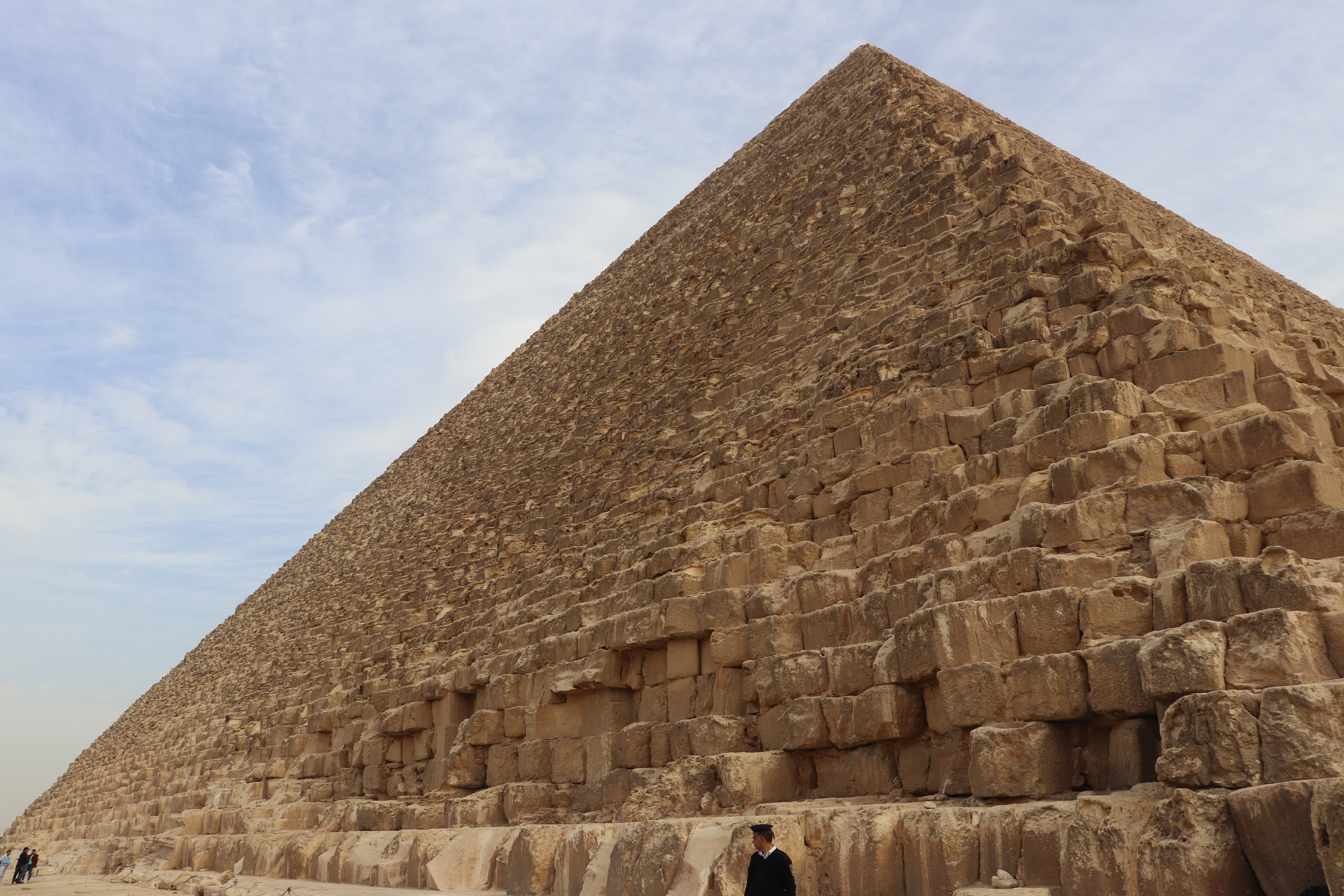
There are some 90 pyramids, built near the old capital of Memphis. The Great Pyramid of Giza was built about 2600 BC with 2.3 million limestone blocks of 2.5 to 5 tons. 148 meters tall, it faces true north. It took 27 years to build with both permanent workers and farmers working seasonally. Nearby are the two other major pyramids (Khafre and Menkaure) as well as several smaller ones built for family members. Char and Ann were our adventurous party members, visiting the burial chamber inside as well as riding a camel. We concluded our visit at the Sphinx and its nearby temple with red granite walls (from Aswan). Then we had a delicious buffet lunch at the Mena House Hotel overlooking the Pyramids.

View from Mena House Hotel


Saturday, January 28, 2023

Traversing the Suez Canal


We entered the Suez Canal about 4 AM in the second of two convoys going South. According to the accords signed in 1888, any ship from any nation, commercial or military can traverse the canal. The Egyptian army controls the land for 3 km on each side. It was interesting to see the Suez Canal Bridge because it is closed from 5 AM to 5 PM for security as the convoys pass through. 

Suez Canal Bridge

The canal is 120 miles long can handle ships that are 254 feet wide and a depth of 66 feet. In 2014 a project was completed to build a second canal for about 25 miles, which increased the capacity of the canal. An average of 44 ships traverse the canal each day. The Clio pays $40,000 to cross the canal, but the charge depends on your tonnage and type of cargo and could be as high as $1M. Last year the canal at $8 B in revenue. 

Ann, John, Bob, and Richard on the Suez


When we reach Bitter Lake about halfway through the canal, our convoy will pass the first convoy, and our passenger ship will be the first to exit the canal after about 10 hours. Pilots can only work for 6 hours. At Bitter Lake we also saw the Northbound convoy.  


The canal dig was started in 1859. 120,000 men died during its construction and a million people were involved out of Egypt’s 4 million. The canal opened in 1869. 

Building the Suez Canal


Friday, January 27, 2023

Haifa to Port Said


Captain Orsat Luetic on the bridge tour

We started our day with a tour of the bridge. The captain demonstrated how much the electronic systems have changed in the last 60 years. He also explained how everything has duplicate systems and backup after backup. For example, leaving Haifa last night, all their electronic systems were jammed by a military exercise, and they had to rely on their eyes, binoculars, and channel markers to navigate. We ended our day in Port Said.

Port Said


Thursday, January 26, 2023

Golan Heights and Capernaum


We’re off to visit the Golan Heights; this area was captured from Syria in the Six Day War in 1967. In 1973, during the Yom Kippur War, 48 Israeli tanks, held off 500 tanks by controlling the heights. They ran out of shells, but remained in position, tricking the Syrians. The US supplied the Israelis with new equipment and ammunition, eventually securing the area. From Mount Bental, we could see the caldera of the volcanoes as well as the border roads between Israel and the no man’s land with Syria. Within Israel there are Agricultural fields and windmills as well as the kibbutz village of Meram Golan. Yop, a local sculpturer had several unique sculptures along our path.
Sculpture along our path

We had lunch in the cafeteria of the kibbutz. The kibbutz was founded as a socialist community, where people worked for the various businesses and shared equally in the benefits of housing, food, schooling, and health. The government provided the original investment in 1977 as an effort to settle the Golan Heights with Israeli’s. The UN considers this settlement as illegal under international law. Originally children were housed and cared for in their own dorms. Parents could visit them daily between 4 and 6 PM. In the 1980s, the system was privatized to pay wages, pay rent, buy your own food, and care for your own children. The businesses now include agriculture, orchards, a 70-room hotel, and a quarry. The kibbutz is a tightly knit village of 160 members who run the town and its businesses. Here we had lunch in their cafeteria.

Capernaum excavations

We then visited Capernaum along the Sea of Galilea, now owned by the Franciscans. Jesus spent most of his 3-year ministry in this area. At the time, it was a very Jewish area and along one of the major trade routes. Five of the apostles came from this area, including Peter. Here we toured the ruins of a 4th century synagogue built of white stone above another built of basalt.  Excavated here are buildings from the time of Christ including what is believed to be Peter’s house since a stone inscription had the names Peter and Jesus. A 5th century octagonal church was built above the house. Octagonal because eight represents something new, in Jewish tradition. Above the town. We visited the Italian church built in the 1930s on the summit of the hill where the Sermon on the Mount was given, overlooking the Sea of Galilee.

Sermon on the Mount church

We returned to the Clio for a 5-course dinner and lots of wine.

Our dinner aboard the Cleo


Wednesday, January 25, 2023

Caesarea


Statue of Augustus' Wife

We left Tel Aviv this morning headed north along the seacoast to Haifa. Today, Israel has a population of 10 million in a country the size of New Jersey. It has one of the highest birth rates among first world countries and soon will be the most densely populated country in the West. All the land is owned by the government and leased by the people. Why? Zionism was a socialist idea, since many of its earliest followers had a Russian heritage. It also removed a lot of problems about ownership between Jews and Moslems. Like many western countries, the health system is provided by the government at a rate or $70/month or lower.

Our primary stop was the ancient city of Caesarea, the world’s first artificial port built by Herod the Great in the 1st century B.C. They filled boxes with volcanic ash and sank the boxes to form the port. Herod the Great was an interesting man. Born of a rich Edomite father, whose ancestors had converted to Judaism, and an Arab princess, he grew up in a Greek/Roman culture. He became king of this region by appointment from Caesar Augustus. He honored Caesar by naming the city Caesarea and erecting a Statue of Augustus and his wife in the center of the port. He also erected a temple for the Roman God’s and built a hippodrome for horse races. The temple was converted to a Byzantine church, then a mosque as control of the city changed over the centuries. All was destroyed after the crusades. Herod also built a Palace here where we can see the remains of his pool. The Roman theater is actively used each year. A key find here was a stone tablet with the words “Pontius Pilate, the prefect of Judea, (erected a building to the Emperor) Tiberius”

Pool of the Herod's Palace

We then climbed into the hills to visit the Druze village of Daliyat al-Karmel. The Druze are a religious sect formed by an Egyptian Iman who broke off his group from Islam. Their communities exist in the mountains of Northern Israel. Syria and Lebanon. The sect has about 2M members, and they only marry within the sect. The men usually where white caps and sport mustaches, the women have a white scarf over a black kaftan. In recent years, almost all are highly educated and even the women can be professionals. We had our lunch at the store of woman owned store, who sells health products such as soaps and lotions that she makes herself.

Druze store owner

Then on to Haifa. We had a photo stop of the Bahai Gardens. The Bahai International Center is in Jaffa and the founder is buried on the 13th terrace of the gardens. Upon reaching Haifa, we boarded our 89 passenger ship, the Cleo. 

Bahai Gardens