Wednesday, September 14, 2016

Grand Junction and Moab

Colorado River Valley on Utah 128

If you'd rather see a 15 minute video of this trip it is available at https://youtu.be/bH0SFJNxAIQ

We left yesterday from Fort Collins and drove the interstates to Grand Junction. We met with Jim Liewer and his wife for dinner. Jim has changed much – still has quite the sense of humor. We had a fun evening with Renee and Jim sharing news of our friends and adventures traveling around the world. 

North and South Windows

Today, we took Utah 128 through the Colorado River Canyon and felt minuscule with the huge red walls rising above us.  After dropping off our camper, we headed to Arches National Park. It was a crystal clear day and the rock formations really were impressive. We stopped at each of the road pullouts until we reached the Windows area. There we took the trail to North and South Windows and then the trail to Double Arch. It was just a great day to be out among these monuments. 

Double Arch

Wednesday, August 17, 2016

Indiana Dunes State Park

Indiana Dunes Sunset (Chicago in background)

We’re camped at Indiana Dunes State Park, a great campground. Mary is struggling with her RA today and it poured rain in mid-afternoon, forcing us to have a fairly quiet day. There is a beautiful beach on Lake Michigan here and from the beach you can see the industrial section of Gary, Indiana. In the morning I took a hike along the dunes with a ranger. He explained the natural lifecycle of the dunes. What I found most interesting is how the dunes as they age and move, eventually cover the trees with sand and then about a thousand years later, those trees start to reappear as the dune moves. The end of this hike was at Beach House Blowout. A blowout or parabolic dune is carved out of a dune if the vegetation dies and the wind starts sweeping the dune in a circular fashion instead of straight across (which forms parallel dunes). Here the sand was well exposed, rather than being solidly covered with grasses and later trees. From the top, I could see two other major dunes each just shy of 200 feet above the lake level – covered with trees. The sand here comes from the northern part of Lake Michigan and is deposited in a layer now 200 feet deep into the water. A relatively quiet day – tomorrow we start heading west. We plan to stop at Starved Rock State Park in Illinois for a short hike and Amana Colonies for a German meal.

If you'd like to see more pictures, go to youtube for the 5 minute narrated video.

Tuesday, August 16, 2016

Air Zoo


Air Zoo

The Air Zoo is different – a mixture of many classic planes, children rides, some air simulators, and the space program outside of Kalamazoo, Michigan. With the exception of an SR-71, most of the planes we’ve seen in other museums, though they do have a good collection of World War II planes and trainers. They had the story of Guadalcanal and another on the WASPs. I hadn’t realized that the women aviators only had a 3 year history during the war. The simulators tossed the participants around quite a bit, so we didn’t try them. The space sections was fairly meager, yet we spent about 3 hours here because of their temporary exhibit, Popnology. This exhibit shows how the vision of men (Jules Vern and other science fiction writers as well as inventors) and popular culture (movies, books, TV and Art) have influenced modern technology.  For example, the wrist radio of Dick Tracy or communicator of Star Trek have become the cell phones of today. There was also a great section on fictional and real robots, and how the movie industry has used technology to create the special effects we see today. Then there was a section on 3D printing and its use in making prosthetics.  This temporary exhibit made the museum. 

Curtiss P-40N painted for Libyan desert


Monday, August 15, 2016

Greenfield Village

Cotswold Cottage

We haven’t been to Greenfield Village for quite a few years, yet many of the scenes were familiar. Henry Ford created this park and the nearby Ford Museum in 1929. It opened on the 50th anniversary of the invention of the light bulb. In the village is a recreation of Edison’s Menlo Park labs. Ford, President Hoover, and Edison were here for the opening of the park by re-enacting the discovery on a radio broadcast to the nation. In most of the buildings were period actors who explained the history or meaning behind the building. Also here is the boarding house that was the first to use electric lights and the bicycle shop where the Wright Brothers worked. Then there are just a variety of homes that were moved here: the Susquehanna plantation house, slave’s quarters, New England homes from the 1700s, and a stone Cotswold Cottage. A highlight was the Noah Webster House, known for the Webster dictionary, Webster actually wrote quite a few spellers and reading books. At the time, most children learned to read from the bible. He was trying to create an American school curriculum and formalize the American Language, removing many of the spelling variants and extra letters of English (colour vs. color, rustick vs. rustic). Just down the road was the McGuffey home and school. We finished the village by visiting the craftworks area: glass blowers, weavers, printers and machine shops.

Noah Webster Dictionary

In the afternoon, we visited part of the Henry Ford Museum.  The presidential vehicles from Roosevelt through Reagan were here, including the Ford Lincoln where Kennedy was assassinated. Nearby was one of the first passenger trains – where the passenger cars look like stage coach wagons. The most interesting part of the museum was the “Heros of the Sky” section with many replicas of planes that set the records – the Wright flyer, the Spirit of St. Louis, the Fokker that Byrd used to fly to the North Pole and planes that set speed records. There was a Sikorsky Helicopter from the late 1930s, which could fly up, down, side to side, and backwards, but it took them an extra year to learn how to fly forward.

Kennedy Limousine


They also have a section on Liberty and Justice for all, which starts with the original ideas that formed the United States, but then goes through Lincoln’s freedom of the slaves through the civil rights movements. Included in the exhibits is the chair from the Ford theater
that Lincoln used and the Rosa Parks bus. There is a lot more to see: cars, railroads, Made in America and furnishings, but we were tired. We concluded our visit seeing the 1952, Oscar Mayer Weiner Mobile.


1831 DeWitt Rail Cars

Sunday, August 14, 2016

Detroit

Ford Piquette Plant

We spent yesterday driving through the pouring rain to the Detroit area to visit our friend, Andy. Our campsite while here was a huge private campground at Hass Lake. The campground has four separate lakes, and lots of activities for people to do. We had asked Andy what he recommended to see while we were in Detroit besides Deerfield Village which we plan to do tomorrow. He took us to Ford’s Piquette Avenue plant, the first plant (1904) build by Ford and the birthplace of the Model T. Here they built most of the early Ford models from A through T, before assembly lines were set up. Most of the various early models of Ford are displayed here. What made this an exciting visit, however, was our guide, Tom, a former Ford engineer who explained the history of the building and the cars to us. On the third floor is “experiment room” where the Model T was invented. Upon the metal frame is a car mostly made of wood, chicken wire, and cloth. 

Building a Model T

The car had several innovations: the flywheel magneto which meant the car didn’t need a battery, the simple transmission, which was easier to shift, a flexible chassis suitable for the rough roads, a one piece engine block reducing cost and a lighter weight vehicle. The original prototype engine is there along with the dealer model that was used to help sell the car. The Model T was the first truly affordable car at about $600-900 (about $30,000 is 2016 dollars) for the middle class. It had lots of options like headlights, and a rumble seat. The car was designed in secret, most of the workers didn’t know what was going on, because within blocks were 30 other car companies, and those workers might begin working for them. Tom mentioned that there have been over 2000 American Car makers over time.

Model T Engine and Transmission

After our tour, Andy took us around town showing us the high end neighborhoods in Detroit. But, of course, in between these neighborhoods, we also saw the many abandoned factories of the area. Detroit is trying to repurpose these buildings or at least the land to get people back into the city. 

Friday, August 12, 2016

Mackinac Island

Blockhouse in Fort Mackinac


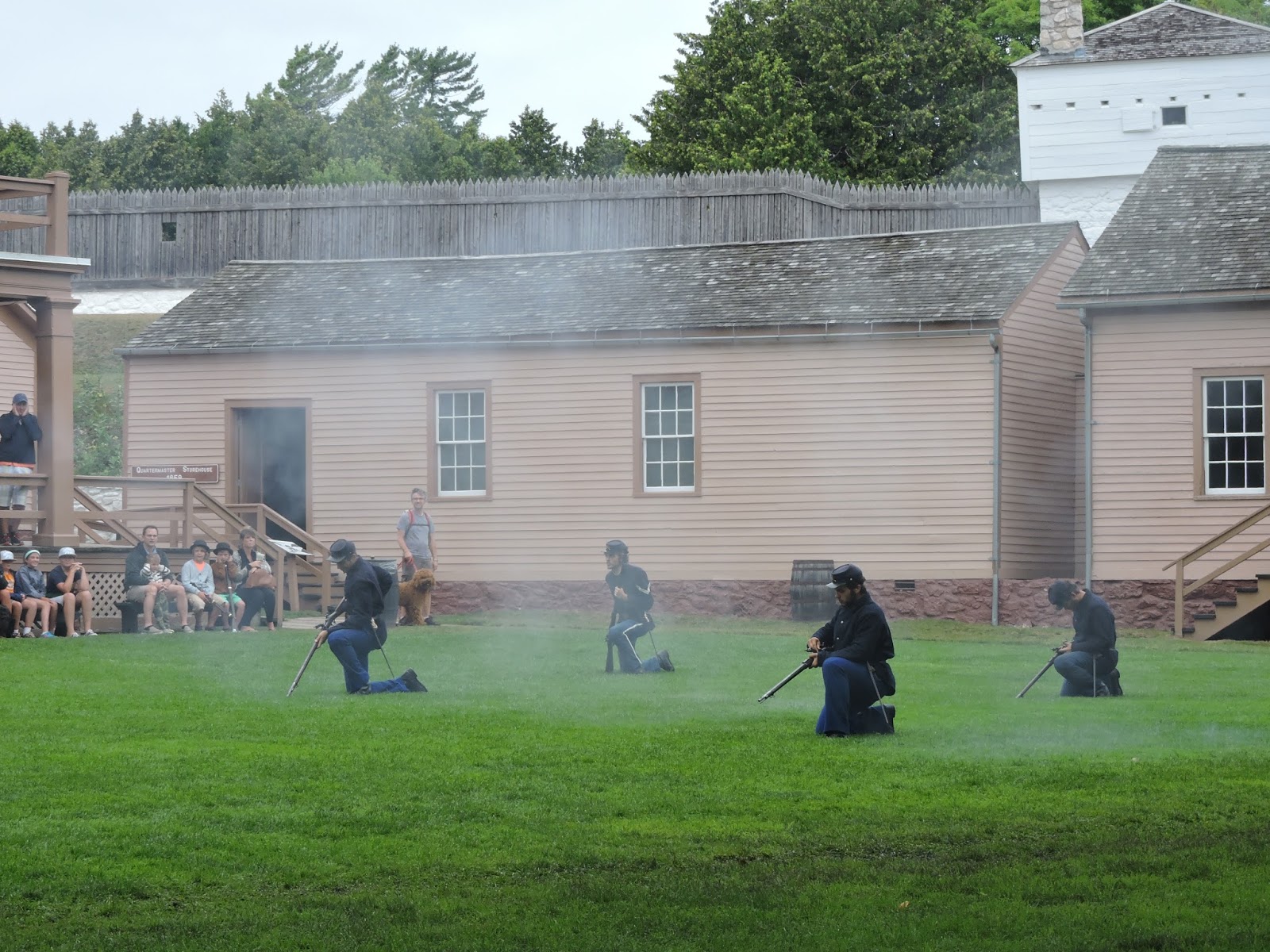
It was only about an hour’s drive down to Lake Michigan, where we camped at the Mackinac City KOA. Shepler’s Ferry to the island provides shuttle service to each of the hotels and campgrounds in the area, removing all the hassles of parking in town. It’s only a 20 minute ferry trip to the island, where they have banned cars since the early 1900’s. Thus there are a lot of bicycles for rent here or you can take a carriage ride around the island. We started by having lunch at Millies on Main, trying out a Yooper Beef Pastie – it was quite good, but then we like meat pies. It was a few block walk to Fort Mackinac, but the last part was uphill to the bluff above the town. This fort was built in 1780 by the British, while the Americans took control in 1796 after the Revolutionary War. It was also the site of the first land battle of 1812,th century barracks, hospital, officer’s quarters, school, and what I found unique: a bathhouse built in 1885 where the men had to take a bath every week! 
as the British attacked with over 500 men (versus the 60 in the Fort), the Americans quickly surrendered seeing that the case was hopeless. The other interesting factoid is this Fort and the surrounding land became America’s second National Park in 1875, an attempt to preserve the natural setting of the area. The fort then was charged with managing the park until it was decommissioned in 1895 and the federal government gave the park to the State of Michigan as a state park. The history is well explained in the park movie. The entire time we were there costumed interpreters were busy explaining what life was like in this fort throughout the decades, even getting the tourists marching to various commands. The buildings of the Fort are well preserved including the original blockhouse from 1798 up to the 19th century barracks, hospital, officer’s quarters, school, and what I found unique: a bathhouse built in 1885 where the men had to take a bath every week!

Re-enacting an attack


Thursday, August 11, 2016

Pictured Rock National Lake Shore


Painted Rock National Lake Shore

The morning started with a ride along the shore of Lake Superior. The sky was cloudy, so this wasn’t as picturesque as we were hoping. Our goal was to reach Munising by noon for the Pictured Rock Cruise along the lakeshore. Lots of people had the same idea, we filled most of two boats. The cliffs rise 200 feet above the lakeshore and except for a few beaches are largely inaccessible except by boat. These formations are made of sandstone and get their name from the bright colors that form along the rocks. The colors come as the water flow from above and seeps into the sandstone, picking up the colors of various minerals to produce white, yellow, green, and red pictures on the cliff. Being sandstone there are also quite a few carved caves and other features, all given names like Miner’s Castle, or the Flower Vase. The water was quite calm so they even took our ship into the feature called Chapel Cove.

Flower Vase Formation