|
| Laura rolling out the mud |
In the town of Azeitão, we visited a tile artisan shop.
Dagmar demonstrated the process beginning with rolling out the river mud, it is
dried for one to three months before being fired for 19 hours, then a white
glaze is applied. They primarily make traditional tiles in blue, white, and
yellow, but can make many other mineral colors. We were given the opportunity
to hand paint our own tile. They’ll fire them today.
 |
| Our cheese makers |
Then we visited a nearby dairy farm, and they demonstrated
the traditional way of making their local sheep cheese. They use wild
artichoke, cardon, to provide the unique taste. Milk is poured through a cheese
cloth that has salt to begin the curdling process. Six of us were asked to help
separating the curds from the whey. Then we were treated to four differently
aged version of the cheese.
 |
| View from Castle |
In the afternoon I did a walk of the Alfama
District. I started at the Cathedral, the church was closed, then the Church
of St. Anthony, tradition says he was born here. Then up the hill to the Castle of St. George
originally built by the Moors. The Castle as several great viewpoints over the
city. The outer walls and the castle walls remain. I walked the castle walls.
There is also a small museum with artifacts from the castle. From here you walk
down this hill and walk up a nearby hill to view the castle from the Church of
Christ, famous for its Christ carrying the cross which is carried through the
streets during Holy Week.
 |
| Entry to the Monastery |
Down the hill is the Monastery
of St. Vincent de Fora. The entry to the Monastery was stunning. Throughout
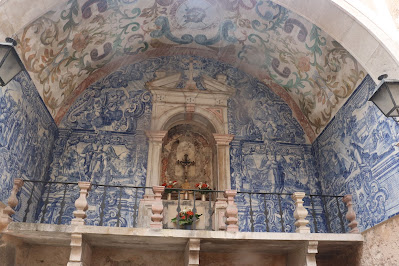
the walls and staircases at traditional blue and white, azulejo tiles. The
sacristy is decorated with marble statues and paintings. There also was an
exhibit of tiles pictures depicting the Fables of La
Fontaine published in 1668. Further down the hill is the National Pantheon
where many famous figures are buried. I hurried past the Fado Museum because
dinner was approaching.