Sunday, February 5, 2023

Bethany beyond the Jordan and Mount of Olives


Elijah and Christ on the Jordan

We started the day by visiting Bethany Beyond the Jordan. This is believed to be the site where John the Baptist, baptized Christ. The gospel of John chapters 1, 3, and 10 talk about the baptism being at Bethany on the east side of Jordan. Helena built a church here in the 4th century. Five churches have been built over that original church. We saw the remains of at least three of these churches. The Jordan was wider then, so the abyss of that church is no longer on the river. We went inside a modern Greek Orthodox church. Nearby is an arch where tradition says that Elijah was raised on his fiery chariot.

Remains of Churches and Baptismal Area


We crossed the border from Jordan to Israel, which took about an hour. On the way to Jerusalem, we passed Jericho surrounded by date palms. Then a few Bedouin families with their goats grazing on grass sprung from the recent rains. 


Eastern Wall and Temple Mount

We stopped at the Mount of Olives with its view of the Eastern Wall built by the Ottomans above the Roman wall, the Temple Mount where the Jewish temple used to be, and the two mosques with the black and gold domes. The Jewish temple was 3 times taller than the Dome Mosque is today and covered in marble. We can see the Eastern gate today is bricked up, but that is the gate Christ entered on a donkey. Below us are numerous cemeteries built here because Christ’s Second Coming is to be from the east.

Cemeteries along Eastern Wall

Saturday, February 4, 2023

Relaxation on the Dead Sea


Movenpick on the Dead Sea

There was an optional tour for Ammon today, but we decided not to go. We had a relaxing day at the hotel. Some of the family got muddied up and floated on the Dead Sea. Some also took advantage of the spa. It was a quiet day after so many busy days.

Char, Richard, Ann, and Steve

Friday, February 3, 2023

Madaba to the Dead Sea


Map of the World with explanation

Our first stop of the day was Madaba, which means city of water and fruit. While the country is 2% Christian, Madaba is 50% Christian and once had 120 churches. We’re here to visit the Church of St. George to see its map of the world, a mosaic created around 542 AD. The top of the map is East, the direction from which Jews believe the Messiah will appear and where Christians believe the Second Coming of Christ will occur. Jerusalem and Bethlehem stand out of the map, with the Jordan River from Lake Tiberius to the dead sea. On another portion is the Sanai desert and the Nile.

Actual Mosaic

We had a family hosted lunch at the home of Ferris with his wife and mother-in-law. Our meal was salad with a delicious chicken and rice meal called ouzi, with lots of Arabian spices, but mild in taste. He had been a pharmacist but now has a small print shop in his home. She has a master’s degree and teaches how to restore mosaics at the University. They have many relatives in the US and Canada, including a brother who worked for HP and Microsoft.

Ouzi

The Jordanians have been doing mosaics for 2000 years. We went to a workshop where they teach people how to create mosaics. It is part of a handicraft protection program created by Queen Noor to provide employment.

Our last stop for the day was Mount Nebo, where God showed Moses the promised land. Here is where he was buried. Down below we could see the Jordan Valley from Gilead to Dan, ending in the dead sea. In the Monastery of Nebo we saw several mosaics from the sixth century. Then we headed for our hotel, Movenpick on the Dead Sea.

Sixth Century Mosaic

In the evening, we had a talk by Rani Husseini, author of “Murder for Honor” and “Years of Struggle”. She went to University in Oklahoma and returned to Jordan in 1993. She worked for the Jordan Times as a crime reporter, where she focused on honor killings of women. At the time, the sentence for men who murdered their wife or daughter because they dishonored the family was 3 to 6 months. She became a women’s right activist to change the laws and sentences. There was a lot of resistance to these issues. Even today, the Muslim Brotherhood is against their movement. Since 2000, there is more awareness of women’s rights, an increase in sentences for abuse and honor killings and there are now three safe houses in the country. In 2003, women were given the vote. Today 20% of the ministers are women. But only 14% of women are employed and there are few day care facilities. There are still no sexual harassment laws, DNA cannot be used to prove paternity, and women’s salaries are significantly below that of men.

Jordanian Economy

The Jordanian dollar is tied to the dollar ever since the Peace treaty between Jordan and Israel. The US and Jordan have a free trade agreement. Your Levi jeans may come from Jordan. Tourism is the largest industry representing 14% of the economy. Isham, our guide is booked to the end of the year except for July and August. Mineral excavation is #2. With the war is Ukraine, the price of phosphate has gone up 20x, for fertilizer. Number 3 is agriculture, fruits and vegetables are grown in the Jordan Valley. Fourth is education, both foreigners going to university, and educated Jordanians working in the nearby countries and sending money home.

The government is a constitutional monarchy where most of the power ls with the king and his cabinet. There is a 130-member parliament with a quota for women, Christians, and Chechens, that is elected every four years. They don’t initiate laws, but approve, deny, or amend them. The king appoints a prime minister who is approved by the parliament, he then appoints members of the cabinet. A 2/3 vote of the parliament or the king can remove the prime minister or cabinet minister.

Thursday, February 2, 2023

Petra


The Treasury


Our forecast was for mid-40s with wind and rain with the possibility of snow. We got lucky, it was just cold and rainy. Petra became the capital of the Nabataean Empire in the 2nd century BC. Moses was believed to have traveled here since Aaron his brother is buried at nearby Mount Hur. This was a rich area because it controlled the nearby trade routes, particularly for Frankincense and myrrh. Most of the buildings are tombs where royalty was buried. The obelisk tomb has 3 benches inside where the funeral services were held. The canyon leading to the city is a slot canyon carved out by water, it’s walls can be 300 feet high. We passed the dams which diverted flash floods into other valleys. We reached the Treasury or Al-Khazneh so called because rumor had it that the funeral urn on top held gold. It is believed to be the mausoleum of King Aretas IV in the 1st Century Ad. The façade is a mixture of Egyptian, Greek, and Roman architecture and measures 130 by 75 feet. Nearby are a series of Nabataean tombs.

The Great Temple


Petra was annexed by the Romans in 106 AD so many of the later buildings are heavily influenced by them. As we reached the city, we passed the Great Temple, the square Qasr al-Bint Temple, and the 4000 seat Roman theatre, all built in 1st Century AD. After lunch, most of us decided to climb the 900 steps to the Monastery. On the way we passed the Lion Triclinium, so named because of the lions on either side of the entrance. The monastery is 150 feet high and 140 feet wide. It was built in the second century and served as a meeting place for the religious and later as a Christian chapel. 

The Monastery


On the way back, I explored the Church built in the fifth century with its mosaics. Then I visited the Royal tombs: Palace tomb, Corinthian tomb, Silk tomb, and the Urn tomb, which also served as a Byzantine church. Here I had a chance to go inside and see the magnificent colors in the ceiling. We ended the day by visiting the Petra museum to learn more about the people. Much of the city was destroyed by an earthquake in 363 AD. The trade routes also moved during the Roman times. The city eventually died in the 7th Century. We walked about 30,000 steps today. The next day Petra was closed with heavy rains and flooding.

Inside Palace Tomb


Wednesday, February 1, 2023

Wadi Rum, Jordan


Seven Pillars of Wisdom

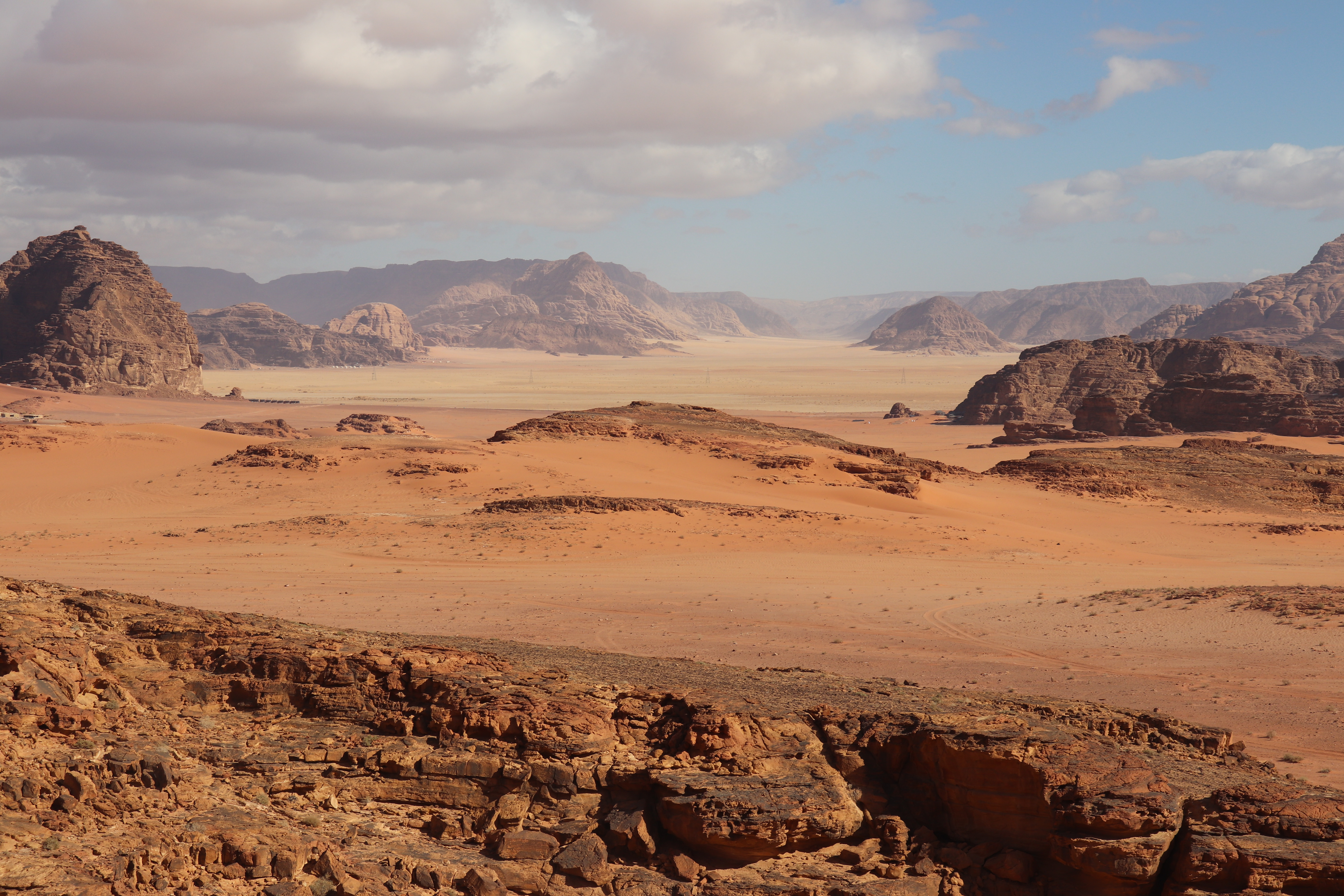
Isham will be our guide in Jordan. The Gulf of Aqaba is a continuation of the Great Rift, from the Jordan Valley north of us. We drove to Wadi Rum, a desert landscape with colorful mountains, like the Seven Pillars of Wisdom rising out of the sand. On another stop, we could see the yellow sand where the movies, Lawrence of Arabia and the Martian were filmed. The Silk Road passed through here and we came upon camel pictographs. The desert is spotted with Bedouin camps. Only 1% of the Bedouins remain nomadic, most have settled in villages with schools for their children. An aquifer provides water so the people raise goats and cows, selling their meat and milk.

Yellow Sands of Wadi Rum

We stopped at one for tea and lunch at another. We had Bedouin dishes of salads and meats that were cooked underground.  They dug up our meal as we watched.

Unearthing Lunch


After many centuries of Arab kings, the Ottomans took control of Jordan in 1500. We passed the narrow-gauge railroad that the Germans built to connect Syria with Mecca. While the Ottomans were Muslim, they were not Arabs. During World War I, Thomas Lawrence offered British help to the Arabs against the Ottomans and the Germans. In 1921 Trans Jordan was created as a British Protectorate. In May 1946, it became the Kingdom of Jordan under King Abdulla from Mecca.

We continued along the Kings highway on our way to Petra. This road connected the ancient kingdoms of Edom, Moab, and Ammon mentioned in Genesis. That night we had a Mideastern dinner at a local restaurant and we’re entertained by male dancers. These are typical dances among males at Jordanian celebrations. They managed to get us involved in the dance.


Tuesday, January 31, 2023

Valley of the Kings


El-Qum, the pyramid mountain at Valley of the Kings

Today we go to the west Bank of the Nile to the Valley of the Kings. Here are buried the pharaohs from the 18th to 20th dynasties. There are 64 Royal tombs dug in the 16th to 11th Centuries BC. under el-Qum mountain that looks like a pyramid. The length of each tomb roughly corresponds to the length of the pharaohs reign. Deep underneath they used a series of mirrors or candles to provide light for the workers. Most have 3 different levels with pictures and hieroglyphics containing the prayers of the dead and phrases for the king to find his soul. The tombs typically have 3 corridors at the bottom one filled with furniture for the afterlife, another the offering room for the burial, and finally the burial chamber itself. Each of the pharaohs were mummified. The internal organs were removed except for the heart and put in jars. The body was cured for 40 days and then wrapped in linen.  

Tomb of Ramses III

The pictures describe the journey of the dead. They journey on a boat through the 12 gates of the night. A monster is at each gate, they must have the password for each gate. The snakes gain more heads as we go deeper. The final test for eternal life is that the heart must be lighter than the sword of justice, otherwise a monster called “yum yum” will eat the heart. In the end passage, the king finally meets the gods.

One and three headed snakes

We saw these stories in five different tombs. Rameses IV was re-opened only two years ago. Ramses VI, Tut Ankh Amun the small tomb, Merenptah also known as Ramses I, and Ramses III. Given the 3500 year age of these drawings, they have amazing colors.


We then had traditional lunch at the home of a local farmer. Our host, Taha, was an 18-year-old grandson of the matriarch of the family. He has 4 uncles and 5 aunts as well as 44 cousins. We had at least 6 cousins around us ranging from 2 to 16 years old. The grandfather and grandmother moved from Aswan to this island 52 years ago. It used to flood regularly, so they brought in sand to raise the island. Now the entire family lives nearby. They grow wheat, alfalfa, sugar cane, vegetables, and fruit in three different fields. They also have 30 sheep, 2 cows, chickens, ducks, pigeons, and a water Buffalo for milk and cheese.

On their house there was a boat and an airplane commentating that the father had gone to Mecca twice. The first time, he went with his wife and 8 other women. It took 33 hours by boat and bus. The women immediately walk around the Hague the traditional seven times. They spent 2 months in the area.

Taha and relatives

Taha has been attending the Koran school, a private school. His hope is to become a doctor, but that requires a 98% grade on the final test, which he takes this Spring. He almost got a scholarship to an American University in a spelling bee in English. He reached the Egyptian semifinals but came in second after 70 rounds.

Feluccas on the Nile

We ended our day by sailing across the Nile on a felucca. We flew back to our ship that afternoon. The day ended with the Captain’s Dinner. That night we sailed from the Gulf of Suez to the Gulf of Aqaba.

Monday, January 30, 2023

The temples of Luxor


We docked in Hurghada about 9 AM. This is a resort town of about 250,000. The drive to Luxor takes about 7 hours, so we flew.

Luxor, then known as Thebes, was the capital of the New Kingdom. Our primary visit was to the Temple of Karnak, meaning fortified village. The temple was built by numerous pharaohs from 1971 BC to 30 BC. The temple is dedicated to a 3-god family with Amun-Re as its head.

Entrance to Karnak Temple

We start with the newest structure, two gigantic walls or pylons, which are unfinished. Behind the walls, there are remnants of the brick ramp used to place the stones of the wall. These walls have no carvings. Just inside are 3 small temples to the 3 gods. Opposite these temples is a side temple built by Ramses III. We know because his cartouche has his two names, his birth name, and his coronation name. 

Cartouche of Ramses II


On the right side, we see him with the red crown of the lower Nile receiving the sword of bravery from God Amun while killing his enemy. On the left side is the same scene, but the king is wearing the white crown of the upper Nile. Inside the courtyard of this small temple, we see the king receiving the symbols of long life, stability, and power. The next room is the garden with stone plants holding up the ceiling. Returning to the main temple, we see two statues of Ramses II. One has him stepping forward, saying he was alive when it was carved. The next has the feet aligned, meaning the king had died. From here we enter the garden area, called the Great Hypostyle Hall with 134 columns each column represents a papyrus plant. The center columns have an open flower, since the windows would have these flooded with light. The inner columns on each side would hold the stone roof, here the flowers are closed. In the last few years, the soot around the temple has been removed, letting the ancient colors appear. 

Great Hypostyle Hall


Here are two of the obelisk built by Queen Hatshepsut, the tallest in the world at the time, the largest weighs 323 tons. Finally, we reached the Holy of Holies where only the chief priest and pharaoh could enter.

Later that evening, we walked to the Luxor temple, built with the same structure, but smaller built in 1400 BCE. We watched as the lights came on as darkness approached. Within the temple is the Abu Haggag mosque built in 640.  Our hotel that night was the Sonesta St. George with the Nile in it’s backyard.

Luxor Temple