Monday, June 24, 2019

Würzberg


Würzberg is the capital of Franconia and has about 100,00 people. It is the wine capital of the region, known for its white wines. Above the town sit a fortress and a chapel. The chapel was meant to attract pilgrims but was kept outside the town to prevent the spread of disease.

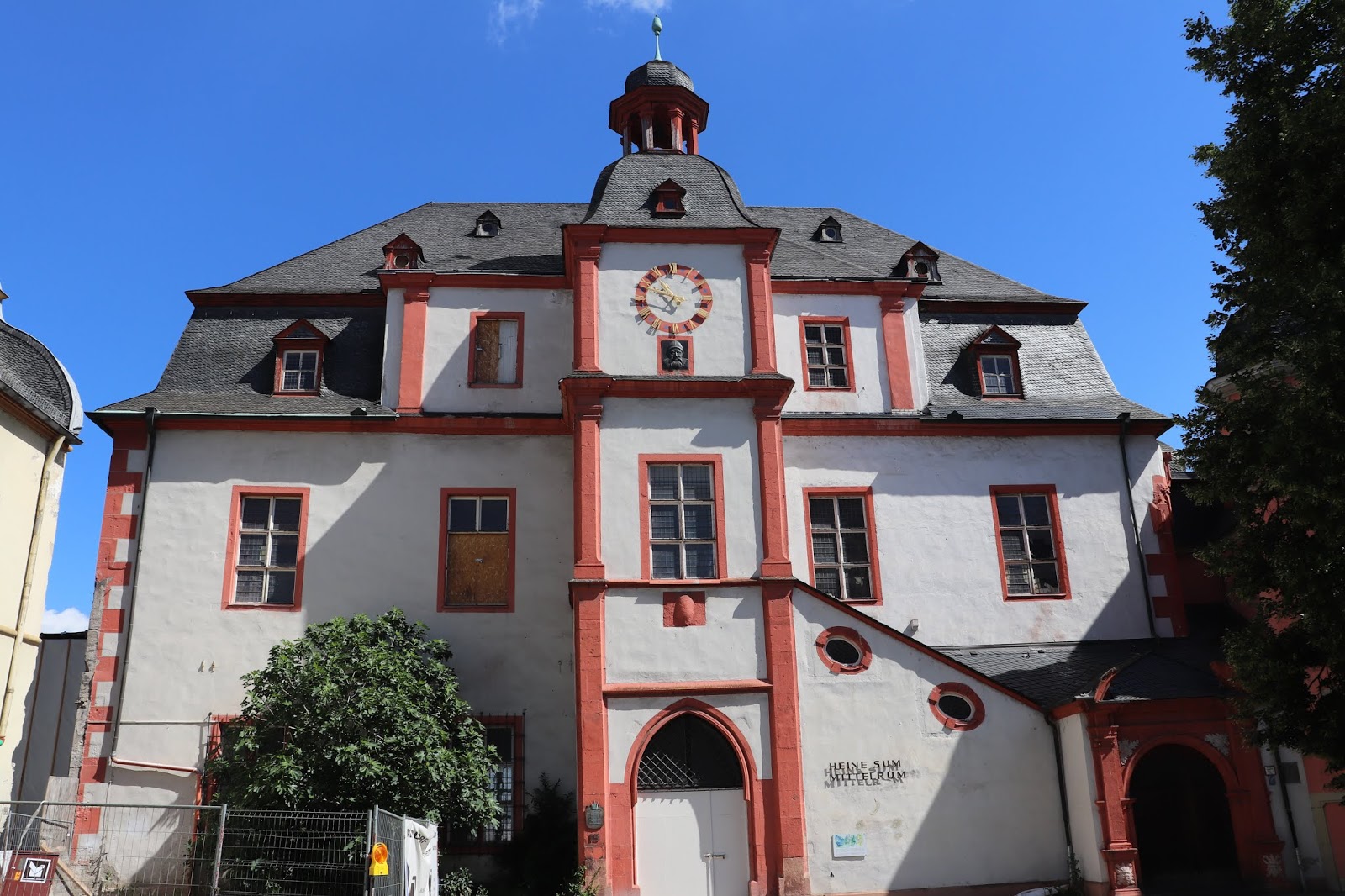
Würzberg Rathaus


The Rathaus, the city hall has a ratskeller, a bar, in the basement. Historically, this was because taxes were paid in grain then the city brewed the grain into beer to sell. The British bombed the city during WW II destroying 90 percent of the city, sparing the churches. In front of one of the squares we found a May Pole. Traditionally the pole would display the crafts that are in the town. The church here had several interesting features:  Atop the beautiful steeple, is a rotating Mary with her feet on the symbols for good and evil, a globe and crescent moon. The front portal shows the last judgement with bishops and kings headed to both heaven and hell, proclaiming to the people that everyone is judged. A side portal has the annunciation with Jesus flowing from God's mouth to Mary's ear. 

Annunciation

The cathedral is dedicated to St. Killian  who converted this region to Christianity. After world war two  the church was shared with the Jews for their services. In appreciation, there is a large menorah in the church.

Menorah in St. Killians

We walked on to the Bishop's Residence a building similar to Versailles. The gardens were beautiful. The chapel was rococo style, every inch filled with building, paintings, statues and decorated columns, the ceilings were three separate ovals. Many folks took the English tour of the residence, a worthwhile tour, but we headed back to the ship, since temperatures were in the low 90s.

Gardens of the Residence


After a sauerbraten dinner, we had a zither concert. The zither has 42 strings. The left hand operates the frets for the melody picked by a thumb pick, the 2nd and 3rd fingers act like a rhythm guitar, while the 4th and 5th fingers play the base notes.


Germany after 1945

Germany ended the war with 12 Million homeless, 5 M displaced, 8 M Polish of German descent expelled from Poland, and 3.6 expelled from Czechoslovakia. There was enough building rubble to encircle Germany with a wall 6 ft. wide and 21 ft high. What housing was available was shared, rooms allocated based on the size of your family. There were food shortages for another three years. Germany and Berlin were divided into four occupation zones: American, British, French and Russian.  The first cold war crisis was when Russia blockaded the road corridors to Berlin. The Berlin airlift supplied West Berlin with goods, even delivering a power plant piece by piece by parachute. The US helped rebuild Europe with $13B from 1945 to 1948 and $12B from the Marshall plan from 1948 to 1952. In 1949 the Basic Law (constitution) was adopted and the Deutchmark became the currency. By 1952 Germany's GDP was 35% higher than before the war. In 1955 occupation ended and Germany joined NATO.

Meanwhile Russia shipped $10B of goods out of East Germany as reparations by 1952. The German Democratic Republic (GDR) was declared in 1949. A series of 5 year plans were economic disasters, agriculture and industries were nationalized. The Berlin wall was built in 1961. A forbidden forested zone was created along the West German border. After the fall of the USSR, the GDR voted itself out of existence and each state voted to join West Germany. Reunification happened almost overnight. Of course this required a lot of infrastructure to be built. West Germany still pays a solidarity tax to rebuild East Germany.

Sunday, June 23, 2019

Wertheim


Wertheim has a glass blowing school here, so we had a glass blowing demonstration. Deiter had 4 ½ years of schooling and apprenticeship to become a scientific glass blower. He then went to Anaheim where he learned artistic glass blowing. His most unique creation was a crystal pyramid that sounds like a bell chiming. We bought an unique oil and vinegar vase.

Wertheim was a duchy between two larger bishoprics so it was caught in the middle of their feuds. The town is built at the confluence of the Mein and Tauber rivers. The tower here was used at for a time as a prison. Drunks and quarreling women were lowered to the dark bottom of the tower for their sentence. As we walked through the town we saw several remembrances for the Jews who had lived here: a support beam from the synagogue and memory stones in front of houses. But we also saw a Chapel to Mary, built over a middle aged synagogue, a common practice of the time.

Memory Stones

Wertheim from the castle

We climbed to Wertheim Castle above the town. Its primarily a ruin, but the views were spectacular. We got our exercise climbing up and down stairs to the ramparts and towers. We also found two owl chicks hiding in the shadows.

Two owlets in the shadows


We had the pleasure to have dinner with Captain Boris from Croatia. Actually the majority of our crew is from former Yugoslavia with most others from Eastern Europe. Working on river boat is a better job than they would have at home. Though our Romanian hotel manager pointed out that there now is a shortage of workers in Romania, so perhaps wages will go up.

Jews in Europe

That evening , we had a lecture on the Jews in Europe. Beginning in 1215, Jews were not allowed to be tradesmen or farmers, so they became scientists and money lenders (forbidden to the Catholics as usury). This created a natural animosity, when you couldn't pay back your loan. What better way to solve your problem than to get rid of the Jew who made the loan. During the plague times, the Jews were less prone to the plague because they had ritual baths weekly, but they were accused of poisoning the wells. The synagogues were torn down three separate times in medieval times. Napolean changed things, announcing freedom of religion. The Jews were actually German soldiers in World War I. Hitler made use of this by blaming the Jews for losing WW I and for hoarding the wealth of the country. They owned 10% of the riches of the country while being only 1% of the population.
In 1933, Wertheim made Hitler an honorary citizen. Soldiers were placed outside each Jewish business to discourage business. When a Jew shot a German diplomat in Paris, the SS arranged "spontaneous demonstrations", destroying 7000 Jewish businesses and 1300 synagogues. Most Jews left the country, but as Germany conquered other countries, the Jewish population grew. Few other countries would accept Jewish refugees, fearful that they would change their culture because they weren't Christian. The “Final Solution" started as soldiers shot up to 40,000 a day a total of a million were shot. Gas chambers were built to be more efficient. Didn't the German population know? Even if you knew, you wouldn't jeopardize your families lives by saying or doing something. It was best to not know. After the war, it wasn't talked about, because you had your own problems. Finding food and shelter in a destroyed country. Many had also suffered during the war from the Allied  bombings. The war was something to forget.

Saturday, June 22, 2019

Heidelberg

Heidelberg with castle


Heidelberg is home to one of the nine electors of the Holy Roman Empire. When the emperor died these electors would choose one among them to become the next emperor. This area later became Lutheran which led to many wars between the Catholics and Lutherans. Heidelberg castle was destroyed during the war of succession. In the middle ages, a stone bridge crossed the river here, making this a rich town for commerce. The Church of the Holy Spirit is unique. At one time it was both used as a Catholic or Lutheran church. On the outside, there are gargoyles for the Catholic portion and none for the Lutheran.

University Prison


Heidelberg is famous for its university. Today, if you join a fraternity you can have free housing while you're studying and then you pay back after graduation. It was traditional to have sword fights between the fraternities, a badge of honor was to have a scar from a blade. We visited the student prison where students would be jailed from a few days to a few weeks. The first two days you were on bread and water. The walls are filled with silhouettes, sayings, and names. It was an experience one could brag about. There was also an exhibit on the history of the University: the founding, when women were allowed to attend, the “cleansing of the faculty" by the Nazis, the student protests in the 60s, etc. For lunch we had a local dish, “the feeding bag" finely ground pork mixed with spinach in a pastry shell. Created by monks to hide the meat which they were forbidden to eat.

Frederick V portion of castle

Heidelberg castle was built over many years, but primarily by Frederick V who started the war of succession. The Renaissance building was built by his father. The castle is mostly ruins, due to lightning strikes and the stone being reused by the villagers after the castle was abandoned. The tower of the castle, which stored gunpowder was blown up by the French. Inside is a huge wine cask, where the wine taken as taxes was stored with a dance floor on top. It must have been a lousy wine with the mix from every vineyard in the area. The pharmacy was fascinating with multiple rooms from different times and places including a drug preparation room.

The 58,000 gallon wine cask


We drove two hours to finally meet our ship. The crew was as happy to see us as we them, they could serve us instead of maintaining the ship. 

Friday, June 21, 2019

Lorelei

Koblenz Square

We started our day in the town of  Koblenz, named by the Roman’s “the fortification on the confluence" of the Mosel and Rhine. Our first square was the location where John Luther (not Martin Luther) was beheaded. It turned out he was innocent of the crime so the clock here is a memorial to all innocents, the face sticks out its tongue on each chime.

Next door is the building that was the Jewish synagogue, only 20 of the 700 Koblenz Jews survived World War II. In front of most the former Jewish homes are stumbling stones commemorating those who died. Exacting plans were created for the “spontaneous" demonstrations like Kristallnacht against the Jews. Most people were in favor of shipping the Jews off to concentration camps. The Nazi propaganda was effective at stirring resentment against the Jews until the Allied  bombing began and the people discovered that Hitler wasn't all powerful.  We ended our tour at the statue of the spitting boy, a fountain that can get you wet, when the fountain sprays water onto the square. We enjoyed a ham sandwich on the monastery square, then walked along the Mosel river before catching our bus.

Spitting Boy Fountain

The afternoon was spent cruising the Rhine river along the castle section of the river. There are quite a variety of castles along this section. They were built primarily by prince bishops (both a civil and religious authority) to collect tolls from ships plying the river. Most were built before the 15th century, many were either destroyed by the armies of King Ludwig or Louis, the 14th as the wars between the French and Germans occurred. Some remain in ruins, but most have been rebuilt into residences or hotels. We passed by several hazardous sections, including Lorelei rock, where the shipping channel narrows.The story is that an attractive blond would lure the sailors onto the rocks.

Pfalz Castle


A castle legend

Many of the castles have legends associated with them:
Sir Diethelm of Burg Rheinstein was not rich but he found consolation by thinking of his beautiful daughter, Gerda. Once Gerda reached marrying age, her father often daydreamed of a rich suitor who would share his fortune with him upon marriage to his daughter.

Reichenstein Castle


Helmbrecht, eldest son of the old Knight of Sternberg Castle, lacked neither looks nor youth, but did lack riches and family fortune. However, this did not prevent him from wooing Gerda. Helmbrecht went to his uncle, Gunzelin of Burg Reichenstein, and asked him to speak to Gerda's father on his behalf. Gunzelin was a grey haired giant possessing a vast fortune. Due to the close proximity of Burg Reichenstein and Burg Rheinstein, Gunzelin was well aware of Sir Diethelm's desire regarding a wealthy son-in-law. At their first meeting, Gunzelin found Gerda so beautiful he asked for her hand in marriage.  Blinded by Gunzelin's wealth and stately appearance, Gerda's father agreed to their marriage. The ceremony was scheduled for a few days later in St. Clement's Chapel  which lies on the banks of the Rhine between Burg Reichenstein and Burg Rheinstein. However, Gerda became quite distraught upon discovering the name of her future husband, she cried aloud with anguish, and broke into tears. As everyone knows water creatures are attracted to tears from near and afar. The water-nymph who heard Gerda's sadness, knew what needed to be done.

Rheinstein Castle


On the day of the wedding, the bride and groom began their journey to St. Clement's Chapel. This route included a hornet's nest firmly entrenched
at the side of the road. As the couple approached it, the water-nymph threw a jagged rock right into the hornet's nest. As a result, the hornets swarmed and began stinging the horse, which was transporting the couple to the chapel. The horse stood on his hind legs and threw Gunzelin over a cliff to his death. Gerda was rescued by Helmbrecht who was wallowing in his sorrow near the chapel.

St. Clement's Chapel

A week later, Gerda von Rheinstein married Helmbrecht in the same St. Clement's Chapel where, after a lifelong happy marriage, they were both laid to rest.


Thursday, June 20, 2019

Colongne


We had a four hour drive to Cologne, the river boat would have been more fun! We heard that the ship was now through the broken lock, but it has many locks to go before it can reach us. We'll see how many nights we spend at a hotel in Frankfort. Tonight we’re staying at the Marriott right next to the train station, close to the Cathedral.

Train Bridge and Cathedral 

Courtesy of Judy Cannon
We went into the Cathedral, but it was Corpus Christi, so mass was being celebrated. We decided to have lunch just off one of the squares. Most of us tried bratwurst  it was delicious. We ended up being 5 minutes late for our tour, but found Stefan nearby.

Cathedral Altar Piece

The Dom Cathedral is the largest gothic cathedral in the world, but it took 800 years to complete. During WWII it suffered collateral damage because the train station near by was a primary target. The stained glass windows were removed so many of them remain from the 15th century. There was also one large pixel window, made of circular pieces of modern glass with traditional colors. As usual there was scaffolding, they are continually refurbishing parts of the cathedral.

Roman Mosaic Tile

Cologne was founded by the Roman’s because of the hot springs here. We saw a large mosaic floor from Roman times. As we walked through town we had a mix of old and new styles. Before Napolean there were no street addresses, so houses were painted different colors to distinguish them.  Napolean also introduced last names to commoners, previously only used by the upper class. We saw several interesting fountains. The elf fountain was based on the legend of elves cleaning up for a tailor at night until his wife discovered them , when they promptly disappeared. We also saw several versions of Tunis and Schell, popular figures for jokes.

Tunis and Schell


Wednesday, June 19, 2019

Amsterdam


The Canals of Amsterdam

Amsterdam in the 16th century was the richest city in the world, due to the Dutch East India company shipping spices to all of Europe. It also became a protestant stronghold because Catholic Spain controlled most of Belgium and the Netherlands and gave people a choice: convert or move to Amsterdam. We toured Amsterdam on the canals in the rain. The legend here is that God created the world, but the Dutch created the Netherlands. Sixty percent of the country is less than a meter above sea level because of damming the sea and pumping out the water with windmills. As we toured the canals we saw many houseboats or buildings on the water. Amsterdam has over 2500 houseboats. The houses here are narrow since taxes were based on your frontage on the canal. Each also has a beam to hoist up furniture from the canal. Most homes have lots of windows with no shades to declare in Calvinist tradition: “see I'm not rich".

Narrow house with large windows and hoists

In the afternoon we took the ferry across the harbor to where ships used to be built. Now it is an artisan district. While we saw several interesting murals. It was a bust.

Ann Frank Mural

A few of us went to the maritime museum. The most interesting exhibit was their rebuilt merchant ship. It was surprisingly large with lots of storage in the hold, several cannon for protection, and room for 200 men, sleeping in shifts. The officers and merchant had private rooms and a sheltered dining room, the crew ate on the forecastle. The highlight of the ship was a virtual reality viewing of 16th century Amsterdam including the ship building docks. We only had time for a few other exhibits  but the ship models and maps were interesting.

Crew quarters in the Amsterdam


Tuesday, June 18, 2019

The road to Amsterdam


Ghent's Quay

Time to travel to Amsterdam, but our first stop was the town of Ghent, 250K of people and another 60,000 students. Ghent was the center of the wool trade in the middle ages. It also had  a vigorous grain trade and the taxes from this trade made Ghent very rich. We toured the ancient port area. The guild halls were spectacular, the meat hall and the cloth hall underneath the belfry. We also saw the painting “Adoration of the Mystic Lamb". It was one of the first to use shadows to emphasize the curls of cloth on the figures and use depth in the backgrounds. Painted by two brothers, started by one and finished by the other, we find the transition in the painting.

Adoration of the Mystic Lamb

The Old Church Delft


We continued on to the town of Delft. We walked the center of the city: the merchant house, the old church and new church, built between the 15th and 17th century. Of course we also visited a delft pottery workshop, one of only three left. The simple vase we saw was hand painted and takes 8 days to make because of the multiple firings. 

Making of a vase from right to left


We arrived in Amsterdam just in time for dinner. After dinner we headed to the red light district around one of the churches. It was still quiet, so we stopped for a Guiness at an Irish pub. After our beer, the window shades started opening and the women were on display.

We've known for days that we wouldn't be meeting our ship. A Viking ship hit the doors of one of the locks on the Danube. It is under repair and our ship is on the other side. We know we will be using buses and hotels for at least 3 days and possibly up to 7 days, depending when our ship can get through the lock.