Tuesday, June 29, 2010

Peter's Places

Peter and Paul Fortress

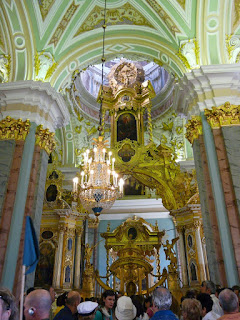
Our first visit today was at the Peter and Paul Fortress, built in 1703 to start the city. It never was used to protect the city, but was primarily used as a political prison, Dostoevsky and the 1917 provisional government spent time here. Today it is largely museum space. Inside is the Peter and Paul Cathedral which is very different from traditional Russian Orthodox churches. Rather than an onion dome it is crowned by a tall spire with an angel on top. The interior also has battle flags, statues, and a pulpit, very unusual features. All the Czars since Peter the Great are buried here, including the family of Nicholas II, who were interred here on July 17th, 1998, 80 years after they were executed. All the coffins are identical white except for Alexander II and his wife, who freed the serfs.

Interior of Cathedral
In the afternoon, we visited Peterhof, built on a hill over the Gulf of Finland. The grounds are covered with 150 fountains, all gravity fed. The entire complex was built to celebrate Peter's victory over the Swedes. It was all destroyed by the Germans during the 900 day siege of Leningrad (St. Petersburg). The Great Cascade is the highlight of the fountains glittering in gold on our sunny day. There are also many trick fountains throughout the park to the delight of giggling children.
Peterhof's Grand Cascade
We also toured the Catherin block, built by Elizabeth I, but lived in by the future Catherine the Great for 16 "miserable" summers, when she was ostracized by her husband. The rooms today are primarily in Empire style with each room in a single color with gilded chandeliers. This was how Alexander decorated it in celebration of his defeat of Napoleon in 1812.

Monday, June 28, 2010

Yusopov Palace

Yusupov Palace
Our historic visit today was the Yusupov palace, home of the second wealthiest family during the 19th century, next to the Czar's family - Romanov. The palace is known for two reasons. First, it is a very livable palace, much more so than any imperial palace. The palace was lived in by 3 people: mother, father, and son with 200 servants. The personal rooms are small, but ornate, but the highlight is the beautiful theatre that could hold 118 people. Second, this is where Felix Yusupov murdered Rasputin, because they felt that he had too much influence over the Czar, Nicholas II.
Palace Theater

Nicholas had married Alexandria, a grand-daughter of Queen Victoria, and after bearing 4 girls, a son was born. Unfortunately, he had hemophilia, which was kept a closely guarded state secret. Rasputin, a self-taught monk, gained influence because he was able to control the bleeding through prayer, when the doctors couldn't. The family isolated itself from the royal court to keep their little secret and Rasputin was one of the few able to get an audience with the Czar at any time. To the court, he was a womanizer and drunkard, yet they would bribe him to use his influence.
Rasputin was invited to the Yusupov Palace by Felix using Irena, his wife as bait. There they fed him cakes with Cyanide, shot him 3 times and when he still was moving, clubbed him, wrapped him in a carpet, and dumped him in the river. The autopsy showed that he eventually died of hypothermia. These events are recounted with wax figures in the basement room where it all occurred.

In the evening, we did a canal tour seeing the city as Peter the Great meant it to be seen from the water. The historic center of the city sports numerous palaces, now being used for many purposes. The weather was perfect for a cruise, low 70's so everyone was in the open air enjoying the sights.

Sunday, June 27, 2010

Catherine's Palace

Catherine Palace Throne Room

A unique day - the 300th anniversary of the founding of the town of Pushkin and we were there. Security is everywhere and roads are closed because the Patriarch of the Russian Orthodox church will be here to rededicate a church. The town was renamed on it's 100th anniversary for the poet, Pushkin, because he grew up here. But we're her to visit Catherine's Palace, named after Peter the Greats wife, but primarily used by his daughter, Elizabeth I. The 2nd floor of the palace is where the royalty lived and entertained, thus it is all glitter. Since the town was occupied during World War II by the Germans most of the building was destroyed and thus the palace is completely rebuilt. The first floor which was mostly servant quarters is not reconstructed yet. The main throne room takes up half of the palace's second floor. When it was built, it was the largest unsupported room in the world. We walked through many rooms filled with glittering gold decorations, chandeliers, and parquet floors to the highlight of the palace, the amber room. This room was dismantled by the Nazi's and the original 100,000 pieces of amber have never been found. It took 8 years to rediscover how to tint the colors of amber from it's natural yellow and black to the reds used in this room, and another 22 years to rebuild the room. Amber is used in many different colorful patterns here. After touring the rest of the palace rooms, we visited the gardens, some French style, some English with their many pavilions. With the short summers (last freeze in early June, first freeze in late August), the gardens were filled with flowers to celebrate the warm months.
Panel in Amber Room

In the evening, we attended Prokofiev's Romeo and Juliet at the Alexandrinsky Theatre. The girl who played the angle of death stood out as the most interesting of the dancers. Both the music and the dancing climaxed in the death scenes, which were charged with emotion. This 19th century theater was one of 5 royal theaters in Russia. It too was a spectacular setting, recently refurbished. Upon leaving the theatre, the sun was still shining, sunset will be about midnight and sunrise at 4 AM. We're in the period of 'white nights' where the sun is never more than 6 degrees below the horizon.

Saturday, June 26, 2010

Russia and Urkaine


Iconostasis of St. Issacs

We had an uneventful trip from Denver to Frankfurt to St. Petersburg yesterday.
Our guide, Misha, joined us this morning for our first day. St. Petersburg was found in 1703 by Peter the Great after he regained this territory from the Swedish. He built the Peter and Paul Fortress to defend the city and personally created the plan for the city. Today, there are 5 million people and 80 rivers or canals separating the city into 42 islands.
We started our tour at St. Issac's Cathedral, the third largest domed cathedral in the world, though it didn't seem that big. Built on former swampland, they pounded tree trunks into the ground and then cut off the tops evenly to provide a solid foundation. It also has one of the first non-masonry domes, it is a triple dome built of cast iron. Originally, the cathedral had many paintings, but due to the high humidity they blackened before the church opened in 1858, so they were replaced with mosaics. Another major restoration was required after World War II since the Cathedral suffered heavy damage. The mosaics had turned black and even the marble was stained. The Mosaics were cleaned, but the marble had to be shaved about 1" in order to recover the colors.


Little Hermitage Pavilion

After a light lunch with vodka, we visited the Hermitage. The Hermitage consists of several buildings, the most historic is the Winter Palace was built in 1762 to serve Catherine the Great. It has 1024 rooms. We saw only a few of the masterpieces in the museum: the Peacock clock, Italian paintings including 2 of DaVinci's 10 known paintings and works by Raphael, the gallery of Canova sculptures and works by Rembrant. As remarkable as its contents are the frescoed ceilings, parquet floors, and ornate doors of the museum itself.

Michangleo's Crouching Boy

Tuesday, October 13, 2009

Thailand - final thoughts

Temple of the Dawn

We ended our trip last night with a dinner cruise on the Chao Phraya river. All the temples, palaces, and churches along the river were illuminated, providing a proper ending to our trip.


So what's my summary of this trip? OAT provided us with two great guides. Chantha was one of the original 26 guides in Cambodia and it showed both with his knowledge and personnal experience. Anil was also a top guide for his country. He was knowledgable about everything we him, but he also had a great sense of humor, kidding almost everyone after he learned a little about out habits. It made the trip much more personal.


I was surprised by the well-developed infrastructure in Thailand: well built 2 and 4 lane highways and cell phone coverage. OAT emphasises not just touring the sites, but interacting with the people and learning the culture. It was particularly good to visit people's home from poverty level to middle class and rich.


We learned a lot about Hinduism and Buddhism and I was shocked to see how much the Thai's revered their king and queen - every home had their pictures among the family photos. And yet, the politicians were considered corrupt. Anil gave us many examples where a politician lined his pockets from legislation that had good goals.


The handicrafts in Chiang Mai were impressive, both their quality and price. What was surprising was how often parents worked in Bangkok, while their home was elsewhere in the country. Usually with the grandparents raising the children. This concentration of jobs in not healthy for the country, I wonder what the long term effects will be?

We had extremely good luck on both the weather and health. While Mary struggled with her knee on occaision (after her May knee surgery), she managed to do almost everything. Dwayne injured his knee and Janet had a scare with an eye problem, but there really were few health problems on this trip. We went during the rainy season, but rain really didn't affect the trip at all. The heavy rains and floods avoided us - 2 days before Siem Reap, flooding in Chiang Mai when we were in Bangkok and visa versa.
Dwayne, Ardath, Janet, Martin, Sharon, Ralph, Laural, Milton, Bill, Flo, Mary & John
The group we toured with was among the best - no complainers, everyone was on time or early. We got along great! By the end of the trip we were tired of Thai food, yet the food was great -
a good variety, always plenty of it, and we got to try a lot of different things - rat (I declined), bamboo sticky rice, dancing shrimp (live shrimp in hot sauce) and lots of different fruits: dragonfruit, pomelo, and the best of them, mangosteen.

Mangosteen fruit in front

While not one of our top 5 trips, I would recommend this trip to anyone, if you want to learn about the culture and people of Cambodia and Thailand.

Monday, October 12, 2009

Grand Palace


Gurundi around Temple of Emerald Buddha

The Grand Palace was built by Rama I beginning in 1782. Previously the palace was located across the Chao Phraya river near the Temple of the Dawn. Upon entering the palace grounds, we first visited the Royal Temple of the Emerald Buddha. First discovered in Chiang Rai covered with plaster, it was believed that the Buddha was made of emerald, but it actually consists of Jade. The Buddha also was once in Chiang Mai, then Laos, and finally here. Three sets of clothes were made for the Buddha for hot, cold, and rainy season.

Royal Panthenon

The upper terrace is particularly spectacular with a gold stuppa in Ceylonese style containing Buddha's relics. The holy library containing the Buddhist scriptures is built of green glass guarded by demons. The royal Pantheon is a mix of Cambodian and Thai styles contains statues of the 8 past Bangkok kings. Finally, there is a miniature of Angkor Wat built by Rama IV. North of the terrace is a golden Chedi with demons supporting the mountain, containing the ashes of the royal family.

Surrounding this temple area is the story of Ramakien (a mile of galleries). This story takes about 14 hours to fully tell. We viewed some of the scenes where the king with help from the white monkey wages war to rescue his wife from an island. (Note: our guide, Anil, had been teasing us for a week about the story of the white monkey.)

We then left the temple area to visit the royal palace area. The audience or throne hall was used until 1932. Today it is only used to crown the crown prince or the king. The Chakri Maha Prasat Hall was built in 1882 (the centennial of the palace) and is a mix of European and Thai architecture. The 2nd floor is used as a royal banquet room today. Finally, there was a smaller throne room, primarily used to day when royalty lies in state.


Chakri Maha Prasat Hall


We ended our tour by seeing all the Royal paraphernalia: many bowls, containers, beetle nut holders, spittoons, amulets, and crowns. All of these were made of gold, emeralds, and rubies.

In the afternoon, most of our group relaxed, but I spent about 3 hours walking both sides of the river. Unique was the Santa Cruz Catholic church built by the Portuguese. Then the giant Buddha in Wat Kalayanamit. I managed to get lost in the back alleys, found many small houses, and monks doing their afternoon chores. I returned to the other side of the river and walked back through the flower market, up to the Grand Palace. On the way back, I walked through the Indian section of town, and about 1/2 mile of pedestrian market, bumping into many of the locals in the crowded market place. Luckily I had figured out that I was still walking in the direction of our hotel.

Sunday, October 11, 2009

Buddhism Experience


Giving alms

Our experience began at 6 AM, the time for the monks to walk the streets giving the people the opportunity for alms giving. This is a chance to give the monks fresh food - either that you have cooked yourself, fresh fruit, or food purchased from a vendor. By calling out "ni mone" the monk will stop and open his pot for you to put the food and then he gives you a blessing. The food will be their meal this morning, for in Thailand, the monks don't cook. They eat what is given both for themselves and any temple boys (the poor) who are being fed and educated at the temple, and finally the stray dogs left at the temple. (No dumb friends league needed here.)

After our own breakfast, we visited Wat Chedi Luang in time for their morning chanting at 8 AM. This is also a Buddhist University offering both Buddhist and secular subjects for those who want to be a monk. Training typically beings at age 12.
We had a monk present us with an overview of Buddhist philosophy. There are 2 branches of Buddhism: the Mahayana branch is practiced in China, Tibet, Mongolia, and Japan. It is a more liberal interpretation: for example you can become like Buddha, monks can marry and participate in sports, the religious texts are written in Chinese. The Theravada branch is practiced in Sri Lanka, and South East Asia. It is a more ancient, conservative form: the language is ancient Pali, priests can't marry or practice sports.
There are five basic beliefs: the 3 gems - Buddha, Dharma (teaching) and Sangha (the Buddhist discipline); karma - your present situation is based on your previous life; and rebirth - that you will be reborn as another living thing with no memory of your previous life.
All Buddhists must practice the 5 principles: abstain from killing, stealing, sexual misconduct, lies and intoxicants. A novice monk has 5 additional principles: no money, sleep on the floor, no marriage, no entertainment, and they only eat 2 meals to be eaten before noon. A monk has 227 principles and a female monk, 311. Most young men become novice monks once or twice in their lives: typically at puberty, and perhaps after graduation from school. They may be a monk for as little as a week, but typically several months.

Three times around the Chedi

Later that morning, we climbed the hill above the city to Wat Phrathat Doi Suthep. According to legend, holy relics were put on a howdah on the back of white elephant, which then wandered to the top of the mountain and dropped dead there. So this is where they built the temple. The present temple is from the 16th century and features a gold-plated Chedi. The entire temple area has been donated, everywhere there are name plates of the donor - from pillars to bells to statues to Buddhas. We observed people walking 3 times around the Chedi with a lotus flower and 3 incense sticks. In other places people were donating on money trees (metal trees in the temple) or blessing themselves with holy water. Many of the monuments had pictures or name plates indicated whose ashes were contained therein.

In the afternoon, we visited a bronze factory, hand making tableware and statues.The real surprise was an umbrella factory where they made the umbrellas out of mulberry paper with bamboo frames. But the highlight was the hand painting. For about $1.50 they would paint a T-shirt or backpack with beautiful designs.

Handpainting an umbrella


In the evening, we had a home hosted dinner. Our hostess was fairly well to-do, her husband runs a vegetable business in Bangkok. They had a beautiful home with ornate wood carvings everywhere. She had both an indoor and outdoor kitchen with modern appliances. Her nieces and nephew cooked us a great Thai meal. A highlight was the salad we fixed ourselves: first we crushed garlic and peppers. Then we crushed green beans and cashews. To this we added a 1/2 measure of fish oil, 1/2 measure of lime juice, and a full measure of sugar water. Then we mixed in the other vegetables and fruit: pineapple, tomato slices, apple chunks and shredded carrot. It made for a nice salad. The other group went to a different house, and they had quite a night. Their hostess was a dancer, so after dinner they learned to dance the traditional Thai dances.