The only real problems for this entire adventure was our return air flight. We left for the airport about 10 AM on Saturday. Air Indigo, our carrier from Katmandu to Delhi, wouldn't check our luggage through to our final destination, only to Delhi and said it would all be worked out in the transfer area of the airport. When we arrived in Delhi, we couldn't leave the transfer area until our bags had been transferred from Air Indigo to Air India. After about half an hour of waiting, members of our group started taking action. One called the regional director of OAT, who then got the Airport hotel manager involved. The Air India folks kept reporting that Air Indigo was ignoring their phone calls to transfer the luggage. Eventually the airport manager was called to help resolve the problem. After about two hours, they started writing down our information - name, passport, continuing air flights, final destination, and took our Delhi baggage claim checks. We ended up waiting 3 1/2 hours in this transfer area (with no water or food) before the baggage was transferred and we could get our boarding passes from Air India. Then Mary and one of our other tour members were randomly picked by TSA to get a special screening of their luggage, which took another hour. Finally about 7 PM, we made it to the airport hotel. Since we hadn't eaten since breakfast, our first concern was food and drink. We finally got to our hotel room at 9 PM before our 2 AM flight. So we managed to rest for about 2 1/2 hours before it was time to get up and find our departure gate. Happily, we were met by our baggage in Denver (and everyone else also got their baggage).
So how do you summarize this trip? It was everything I expected - an introduction to a different culture, interesting architecture, friendly people, and yes, it was an assault on the five senses. As you may be able detect from the length of my blog entries, I took more notes and learned more things than on any other trip we've been on. As others had told us, we did get tired of the food, there are just so many ways you can fix vegetables, chicken, and goat meat, but we were pleasantly surprised several times with some unique dishes, particularly in Nepal. I have to give full credit to our guides, both were quite informative, and Prashant really made an effort to ensure that we had alternative activities during our free (or rest) time, as well as engaging Indian people in conversation so we could better understand the real people. And there were lots of surprises. The biggest negative surprise was how extensive the air pollution was, even in the countryside, we couldn't escape it, and most of us ended up with a hacking cough. There were many positive surprises: the poverty wasn't any worse than other third world countries, the beauty of inlaid marble, the best prices on silk rugs we'd ever seen, our hotel outside of Ranthambhore, our very interesting host at the home-hosted dinner, and Katmandu was a complete surprise, it's contrast to India and the beauty of the mountains and countryside. My recommendation: don't do this trip as your first third world country visit, but also don't miss out on visiting this fascinating country.
If you would rather view a video than read a blog, there is a 30 minute video available on Youtube.
Sunday, November 11, 2012

Friday, November 9, 2012
Bhaktapur
 |
| Pottery Square |
We walked further to pottery square which is usually filled with drying pottery, but this time the pottery shared space for drying rice. Here, too, they were preparing for the festival of lights starting in five days and making a lot of closed pots with a slot, the local version of a piggy bank.
Our final stop was the tallest temple of Nepal, built in 1702. Up the five levels were wrestlers, elephants, lions, griffons, and goddesses - symbols of power different than we had seen elsewhere.
Then we headed up into the foothills going from 2500 feet to 6700 to get a view of the Himalaya mountains. The road was a little wider than one lane, but it was paved. We had to back up several times in order to find a spot where a bus or truck could pass our bus. At the top there were a lot of clouds hiding most of the range, but we did get a peek of Dorje Lakpa, a little over 21000 feet high.
 |
| Dorje Lakpa from our restaurant |
On the way down, we got to do a little 'trekking' in farm country. we passed a number of farm houses with electricity and satellite dishes. The terraced fields of mustard seed were beautiful and the people friendly - kids greeting us and asking for candy.
In the evening we had a farewell dinner with traditional Nepalese food, the local liquor which flowed freely and yogurt for dessert as dancers gave us a sampling of the various regional dances.
Thursday, November 8, 2012
Mt Everest
We rose early to take a 6:45 AM flight around the Himalaya mountains, but they couldn't get one of our turboprop jets running. After a couple of attempts, they brought us back to the terminal. We finally re-boarded the plane and took off about 8 AM. It was a gorgeous, clear day once we rose over the clouds in the Katmandu valley. We were able to see the entire range of mountains in Nepal from Langtang Lirung in the east to Nuptse, Mt. Everest, and Lhotse in the west. These major peaks all ranged from 20,000 to 29,000 feet in height. Particularly impressive were Melungtse, huge and alone, and Cho-oyu in a cluster of four peaks.
After breakfast, we walked through the village of Khokana, a farming community. Most of the town was engaged with the rice harvest - straw mats were laid everywhere, on the streets, the squares, and the roofs, to dry the rice in the sun. We also watched the crushing of mustard seed for oil. The first processing is done by hand, the second by machine. The fields were lain with rice straw - drying it out for use in mats and mattresses.
We ate lunch just off the central square in the town of Patan, where our guide, Rajiv, was raised. Here we visited Patan Durbar Square - the palace of the local king (rebuilt in 1937-51) as well as a number of Hindu and Buddhist temples. Here one could clearly see the contrast between Pagoda (from China) and Shikawa (from India) architecture for the temples. We also visited the religious square of the palace indicated by buffalo intestine over the doorway. A short walk away was the 12th century Golden Temple of Patan, inside is a golden Buddha. Here the chief priest is a 12 year-old, who serves as priest for a month.
Finally, we visited Patan's Kumari, the living Goddess. (Yesterday, we had visited the home of the one in Katmandu. There are five of these girls throughout Nepal.) She lives in her own home and we were able to meet her. It is believed that energy leaves from your fingers and is absorbed by your head, so she applies a red Tilaka (dot) transferring energy from the goddess to us. This Kumari was chosen at age eight and is now ten years old.
After breakfast, we walked through the village of Khokana, a farming community. Most of the town was engaged with the rice harvest - straw mats were laid everywhere, on the streets, the squares, and the roofs, to dry the rice in the sun. We also watched the crushing of mustard seed for oil. The first processing is done by hand, the second by machine. The fields were lain with rice straw - drying it out for use in mats and mattresses.
 |
| Drying Rice |
 |
| Patan Durbar Square |
Wednesday, November 7, 2012
Katmandu
Our day started with a visit to Katmandu's old city, home of the palace and many Hindu shrines. In the 18th century the first king to control all of Nepal built his palace here. The palace has been built over several centuries. Yesterday was election day in the states, so we're eagerly watching updates in the news and on smart phones to see who won.
We visited house of the living goddess, Kumari. This girl is selected from among the Buddhists, she must have no injury, be brave and thirty-two aspects of her body must be perfect. Of those who are deemed acceptable , the elders choose among the youngest. The current Kumari was selected at age 4 and is currently 7. She is removed from her family to live in this special house. Thirteen times a year, during religious festivals, she comes out into the city on a chariot. Upon reaching puberty, another will be selected.
Surrounding the palace are many Hindu Shrines. As the people worship in the shrines, we observed them using all five senses: ringing a bell, offering food, use of red & yellow colors, incense, and touching the idol. Since Hindus are asked to worship before cooking, almost every home has a small shrine for worship. The shrine we visited was built from one tree in the 12th century. The name 'Katmandu' means 'wooden house' from this shrine. Besides the five idols in the shrine, there is stairs rising to a second floor with a pole next to it. Pregnant women who were pain should slide down the pole to remove their pain.
As we toured the palace we also heard the tale of the royal family. On June 1st, 2001, the crown prince, who was said to be on drugs and quite depressed, killed the entire family because his mother wouldn't allow him to marry his sweetheart. Others believe the uncle, who wasn't present, plotted to kill the rest of the royal family in order to become king. Of course, this story circulated widely. At the same time, the new kings son was a known murderer and gambler. So in 2006, there were huge protests for democracy. King Gyanendra
was removed of his powers in 2008 and a constitutional convention was elected. However, at this point, there is still no constitution.
We ate a superb Nepalese lunch at the Boudha Restaurant, where the main course was a soup with vegetables, chicken, and noodles with sides of spinach, dumplings, chicken, rice and noodles, plus a sweet yogurt dessert. This was just outside the Boudhanath Stupa - a key pilgrimage site for Buddhists, built in the 13th century surrounding it are many Buddhist monasteries, primarily built when many Tibetans left Tibet in 1959 after China took control. We were privileged to attend one with a sand mandala newly completed in the center and the monks chanting their prayers. At the end, they made quite a lot of noise with their horns, bells, and cymbals. The second monastery had a statue of the magical master who spread Buddhism to Tibet from India. As we watched - many people were walking around the stupa in a clockwise direction - spinning the prayer wheels and reciting their mantra 113 times on their beads (113 represents all people).
That evening we had a lecture from a Nepalese woman named Shismata who climbed Mt. Everest three times. She is a small, thin woman - one you wouldn't imagine to be a climber. Her first attempt was in 2004, a time when she would have been the first non-Sherpa Nepalese woman to have reached the summit. She ended up 40 meters shy. Why? Her Sherpa didn't feel it was proper for a non-Sherpa Nepalese woman to summit. Instead of leading her up the trail, he followed her, certain she wouldn't make it. But when she was only 40 meters from the top, he held her back by the straps of her backpack and forced her to turn back. On returning to Katmandu, she kept quiet about what happened because she knew that offending the Sherpa would prevent her from ever trying again. In 2007, she was approached by two Sherpa who knew what had happened. In 2006, another Sherpa had left another Nepalese woman on the mountain to die with altitude sickness, while he reached the summit. She was rescued by two Americans. The Sherpa realized that they needed to change the reputation of their tribe. A party of ten Nepalese women was formed, eight of them climbing novices (but trained in climbing). The entire trip was two months long. Teams spend about 2 weeks to get to base camp, 6 weeks going up and down the mountains to the three higher camps bringing ropes and supplies as well as acclimating to the altitude. The final climb from base camp takes a week. All ten women managed to summit.
We visited house of the living goddess, Kumari. This girl is selected from among the Buddhists, she must have no injury, be brave and thirty-two aspects of her body must be perfect. Of those who are deemed acceptable , the elders choose among the youngest. The current Kumari was selected at age 4 and is currently 7. She is removed from her family to live in this special house. Thirteen times a year, during religious festivals, she comes out into the city on a chariot. Upon reaching puberty, another will be selected.
 |
| Hindu Shirnes (with pigeons) |
As we toured the palace we also heard the tale of the royal family. On June 1st, 2001, the crown prince, who was said to be on drugs and quite depressed, killed the entire family because his mother wouldn't allow him to marry his sweetheart. Others believe the uncle, who wasn't present, plotted to kill the rest of the royal family in order to become king. Of course, this story circulated widely. At the same time, the new kings son was a known murderer and gambler. So in 2006, there were huge protests for democracy. King Gyanendra
was removed of his powers in 2008 and a constitutional convention was elected. However, at this point, there is still no constitution.
 |
| Boudhanath Stupa |
That evening we had a lecture from a Nepalese woman named Shismata who climbed Mt. Everest three times. She is a small, thin woman - one you wouldn't imagine to be a climber. Her first attempt was in 2004, a time when she would have been the first non-Sherpa Nepalese woman to have reached the summit. She ended up 40 meters shy. Why? Her Sherpa didn't feel it was proper for a non-Sherpa Nepalese woman to summit. Instead of leading her up the trail, he followed her, certain she wouldn't make it. But when she was only 40 meters from the top, he held her back by the straps of her backpack and forced her to turn back. On returning to Katmandu, she kept quiet about what happened because she knew that offending the Sherpa would prevent her from ever trying again. In 2007, she was approached by two Sherpa who knew what had happened. In 2006, another Sherpa had left another Nepalese woman on the mountain to die with altitude sickness, while he reached the summit. She was rescued by two Americans. The Sherpa realized that they needed to change the reputation of their tribe. A party of ten Nepalese women was formed, eight of them climbing novices (but trained in climbing). The entire trip was two months long. Teams spend about 2 weeks to get to base camp, 6 weeks going up and down the mountains to the three higher camps bringing ropes and supplies as well as acclimating to the altitude. The final climb from base camp takes a week. All ten women managed to summit.
Tuesday, November 6, 2012
On the way to Nepal
We spent most of the day (six hours) traveling to Katmandu. We had to queue up multiple times: to get into the airport, to go to the ticket counter, to get our passports stamped to leave the country, to have our passports and visas checked as legal, at customs, at security screening, to exit the gate, and to enter the plane. As Mary (who had five body scans during this ordeal) said: 'You folks, have felt up my bodymore than my husband has'.
Upon landing, we immediately noticed the differences: streets are cleaner, more motorcycles (compared to scooters), less bicycles, women running shops, fewer people on the streets, schools (particularly those for languages and technology) everywhere. But the air pollution is still here and more people seem to wear masks in the streets to help filter the air. What I found most amazing was that they knew the date of the last snowfall in Katmandu, February 14th, 2003 when it snowed for about 20 minutes. Previously it hadn't snowed for 72 years.
Our brief introduction to Nepal: 26 million people, 3 million live in the the Katmandu valley. Elevations from 60 meters to 8848m. with eight mountains over 8000 m. high. Because of the many valleys separated by mountains there are eighty ethnic groups and 75 dialects. Most people know three languages: their local dialect, Nepali, and Hindi (because they get many Indian TV stations). The next most common language is English. Religions: 80% Hindu, 10% Buddhist, and then 10% other. There really is no industry in Nepal. The government is in flux. Most people try to get government jobs because of the benefits, but many of the jobs are given as political favors. Sometime 3 different people will get appointed to the same job and may all get paid. There is no medical insurance, but both private and public health services exist.
Upon landing, we immediately noticed the differences: streets are cleaner, more motorcycles (compared to scooters), less bicycles, women running shops, fewer people on the streets, schools (particularly those for languages and technology) everywhere. But the air pollution is still here and more people seem to wear masks in the streets to help filter the air. What I found most amazing was that they knew the date of the last snowfall in Katmandu, February 14th, 2003 when it snowed for about 20 minutes. Previously it hadn't snowed for 72 years.
 | |
| Nepal's Flag (the only non-rectangle flag) |
Monday, November 5, 2012
Veranasi
In the morning we rose early to witness people arriving at the Ghats to bathe in the Ganges. Along the shore were umbrellas marking each priest who would offer prayers to Shiva. Chanil, the Hindu priest on our boat offered a prayer for the deceased and then we poured wheat flour, flowers and black sesame seeds into the river. Mary sat before him to receive a special prayer on her birthday after which he tried an orange string around her wrist (for which I forgot the meaning). As we went further down the river, we saw men washing clothes and more Ghats built by the Rajahs from other provinces of India. Pilgrims from the various provinces bathed in the river.
We then left to go to the Mother India Temple inaugurated by Gandhi in 1937. Here was an immense relief map of the Indian subcontinent. Particularly impressive was the valleys of Kashmir and Nepal, surrounded by the Himalayas. Also obvious was the Khyber pass as one of the few passages through the mountains.
After breakfast, we went to a silk embroidery shop with both ancient and modern looms. Simpler patterns are encoded on two boards on the modern (100 years old) loom. Complicated patterns like human figures below, use the ancient loom with multiple patterns dictated by strings. There are over 50,000 looms in Varanasi, of which 300 are employed by the shop keeper we visited.
In the afternoon, we visited the Sarnath, where Buddha began his preaching. He was born in Nepal as a prince, but his father initially sheltered his son from the real world. However, Prince Sitar gave up royalty after observing the suffering of the people. He began traveling and meditating. While meditating under a tree, he realized that desire is the cause of all sorrow. His preaching was about abolishing castes, not worshiping idols, and non-violence. Like the Hindus, he also believed in re-incarnation until you reach heaven where there is no birth and re-birth. We visited the Buddhist temple here where the walls have murals depicting the birth, death and Buddha being tempted. Nearby the temple is a 3rd century stupa.
Finally we stopped at the Sarnath Archeological Museum which houses Hindu and Buddhist art. the most impressive piece was Ashkoa's Lion Capital, the National Emblem of India. (I recommend clicking the link to see the piece.) On top are four lions carved in a polished sandstone, a technique that we don't know how to replicate today.
Our day ended with a lecture from a local philosophy professor about Varanasi and Hinduism. Some of this comments: "Varanasi looks like a careless city, but it is actually a care-free city because dieing here, near the Ganges, one can reach heaven." "People here are happy, even if impoverished." "Why so many beggars? Because tourists and pilgrims give them money. To eliminate poverty, we (government, NGO's) need to give them a job, health, and security." "The caste system is changing to an employer-employee caste in an industrial society. By growing mentally and philosophically, castes will disappear." Heavy stuff.
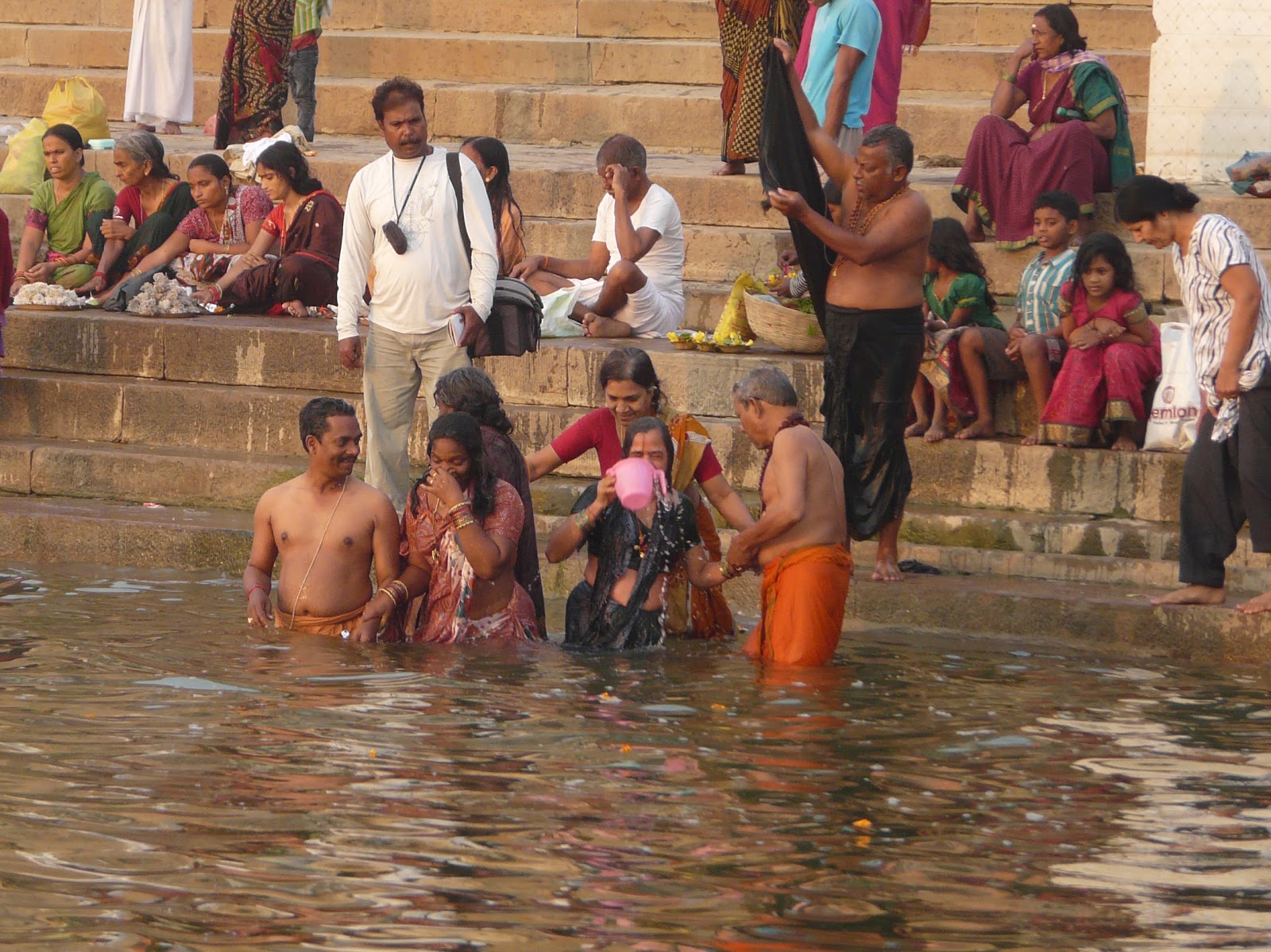 | |
| Bathing in the Ganges |
We then left to go to the Mother India Temple inaugurated by Gandhi in 1937. Here was an immense relief map of the Indian subcontinent. Particularly impressive was the valleys of Kashmir and Nepal, surrounded by the Himalayas. Also obvious was the Khyber pass as one of the few passages through the mountains.
After breakfast, we went to a silk embroidery shop with both ancient and modern looms. Simpler patterns are encoded on two boards on the modern (100 years old) loom. Complicated patterns like human figures below, use the ancient loom with multiple patterns dictated by strings. There are over 50,000 looms in Varanasi, of which 300 are employed by the shop keeper we visited.
 |
| Embroidered figures |
 |
| Buddhist temple at Sarnath |
Our day ended with a lecture from a local philosophy professor about Varanasi and Hinduism. Some of this comments: "Varanasi looks like a careless city, but it is actually a care-free city because dieing here, near the Ganges, one can reach heaven." "People here are happy, even if impoverished." "Why so many beggars? Because tourists and pilgrims give them money. To eliminate poverty, we (government, NGO's) need to give them a job, health, and security." "The caste system is changing to an employer-employee caste in an industrial society. By growing mentally and philosophically, castes will disappear." Heavy stuff.
Sunday, November 4, 2012
Kuajuraho Temples
 |
| Kandariya Temple at Kuajuraho |
 |
| Exterior figures on temple |
We were accompanied by a Hindu priest who recited the mantras to thank god as we put our prayer lamps in the river. Finally we heard the conch horns calling us to Aarti, the sacred light ceremony. There were seven priest on a raised platform above the river. This is the ceremony they performed:
- purify with incense in four directions.
- invoke the god with incense
- swing a pyramid of lamps while chanting
- remove the lamps
- use a large circular lamp with a new chant
- pacify the god by waving a peacock fan
- put the gods back to sleep
Subscribe to:
Posts (Atom)

